An Independent Review for Marketers & SEO Professionals
AI visibility has become a critical component of marketing operations in 2026. As AI-powered search engines and large language models (LLMs) reshape how users discover information, understanding and optimizing for AI visibility is paramount. This report provides an objective, structured comparison of the leading AI visibility tools to help marketers and SEO professionals choose the right platform for their needs.
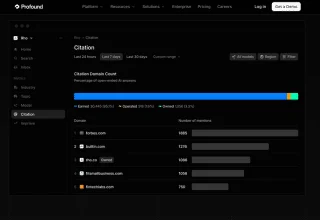
Profound
Best for: Enterprise, regulated industries, multilingual content
- Comprehensive tracking across AI engines with live visibility snapshots
- GA4 attribution, log-level AI crawler data, and content optimization tools (AEO Content Score)
- SOC 2 Type II + HIPAA compliance, plus WordPress & GCP integrations and 30+ languages
- Raised a $180M Series D at a $1.8 billion valuation in September 2026, co-led by Sequoia Capital and Kleiner Perkins
Limitation: High price point, complex setup, visibility only into tracked prompts.
Peec AI
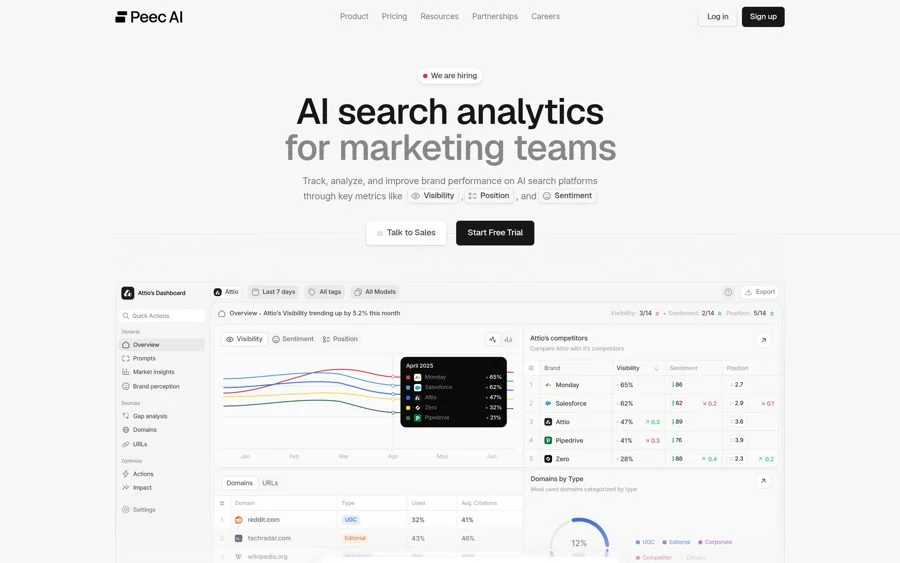
Best for: Agencies and in-house teams seeking smart suggestions and competitor tracking
- Smart AI prompt suggestions + competitor recommendations
- Easy-to-share “Pitch Workspaces” for client reporting
- Looker Studio connector with daily tracking across unlimited countries (all models in plan)
- Published pricing at EUR 85, 205 and 425 a month, dropping to EUR 70, 180 and 360 billed annually
- The Berlin company raised $29M and crossed $10M in ARR by May 2026, about 16 months after launch
Limitation: Lacks deep actionable insights/trend data; baseline plans track only ChatGPT, Perplexity, and Google AI Overviews (more engines cost extra).
AthenaHQ
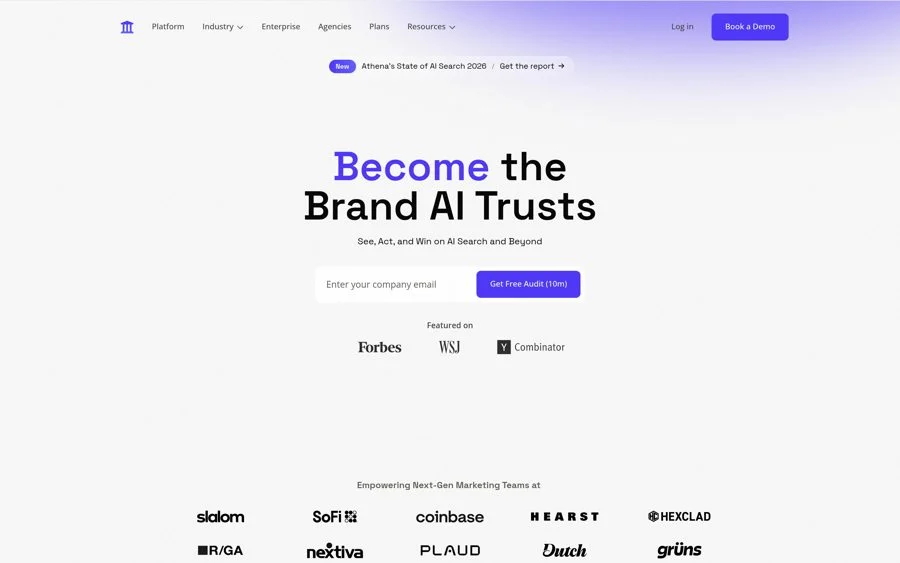
Best for: SEO agencies and mid-market teams focused on conversions and comprehensive analytics
- Tracks brand visibility and conversions with comprehensive web analytics
- Unlimited seats across all plans (ideal for agencies) + free report generation
- Prompt ideas during setup and competitor tracking integrated during onboarding
- Published entry pricing at $295 a month on the Starter plan, among the higher entry points here
Limitation: Lacks advanced enterprise security controls; newer tool with fewer long-term reviews.
AirPulse
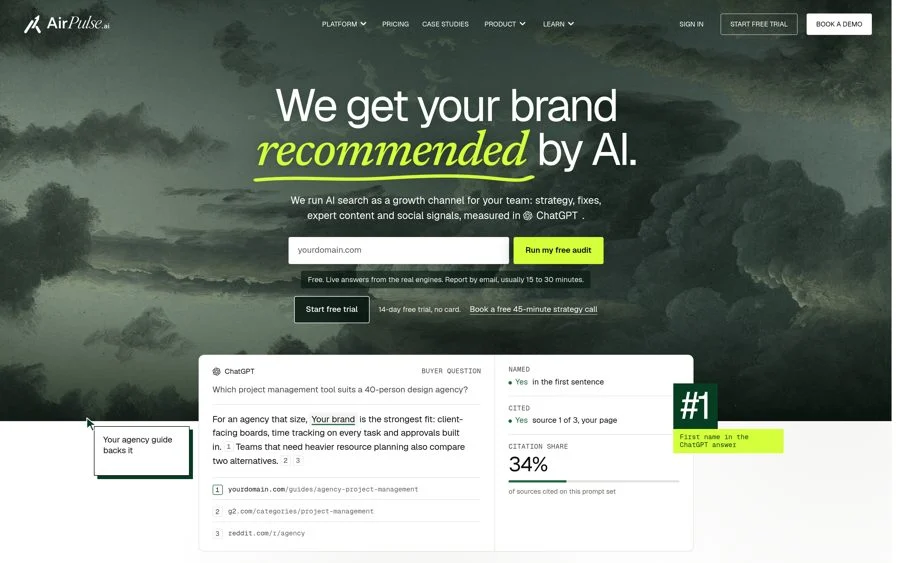
Best for: B2B marketing teams that want the answers published and re-checked, not only measured
- Measures daily, drafts the answer from the sources engines cite, publishes it with schema, then re-asks for the lift
- Agent Pulse reads AI crawler and agent logs and feeds them into the remediation queue
- Published pricing from $89 a month with a 14-day trial and no card; ChatGPT and Perplexity on every tier
- SOC 2 Type II, AES-256 at rest, SAML SSO on Enterprise and a GDPR DPA, on a trust page dated 12 May 2026
- Newton School’s Google AI mention rate went 51.4% to 93.3% over a dated three-week window
Limitation: Gemini is Enterprise-only and Google AI starts at the $179 Growth tier; tracked prompts are capped by plan; no revenue attribution; a claimed 4.9/5 G2 rating matches neither figure on its own G2 listing, which shows 4.8 from three reviews on the category page and 5.0 on the product page.
ZipTie
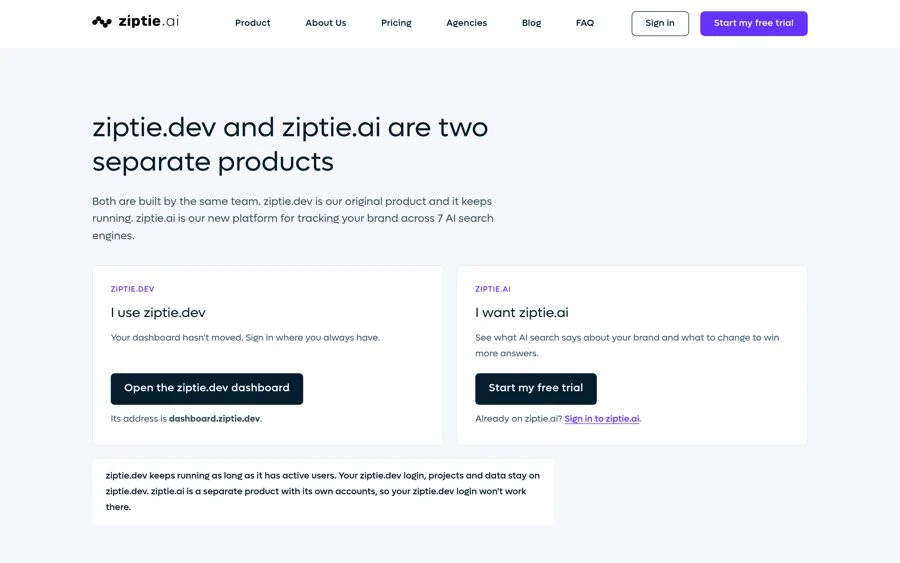
Best for: Teams requiring deep technical analysis and granular reporting of GEO data
- Granular filtering at URL, query, and AI platform levels
- Technical GEO indexation audits + identifies influential URLs
- Proprietary AI Success Score and in-platform content optimization suggestions
- Published entry pricing at $42.75 a month, one of the lowest entry points in this category
Limitation: No conversation data; only tracks Google AI Overviews, ChatGPT, and Perplexity (no add-ons for more engines).
Scrunch AI
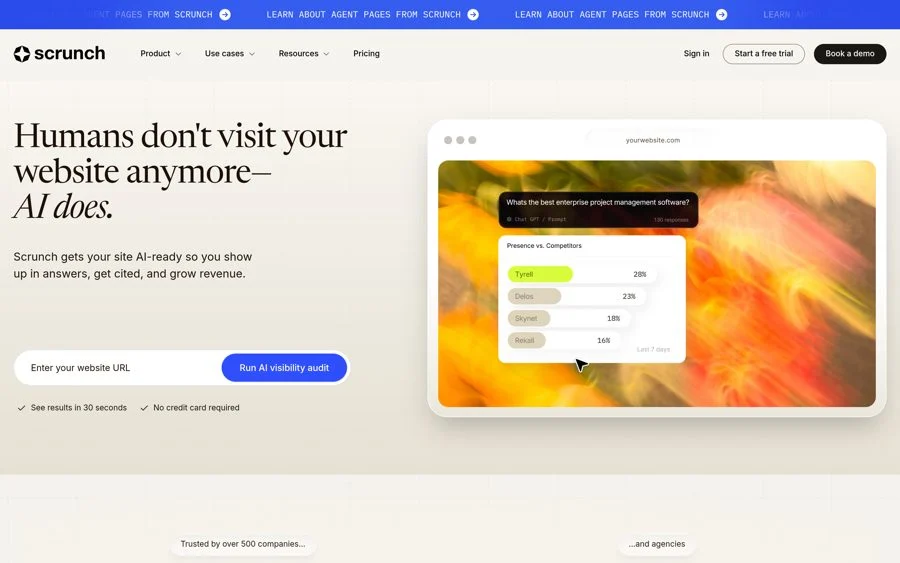
Best for: Huge enterprise companies needing actionable insights for content optimization
- AI-driven insights with specific action items for content optimization
- Tracks citations and spots trends across major AI platforms
- AXP (AI Agent Experience Platform) in beta for creating an AI version of a website
- Sitecore acquired Scrunch in June 2026, after it had raised roughly $26M in total
Limitation: Outdated website design; no self-service option (requires demo); enterprise-focused and pricing can be high.
Evertune
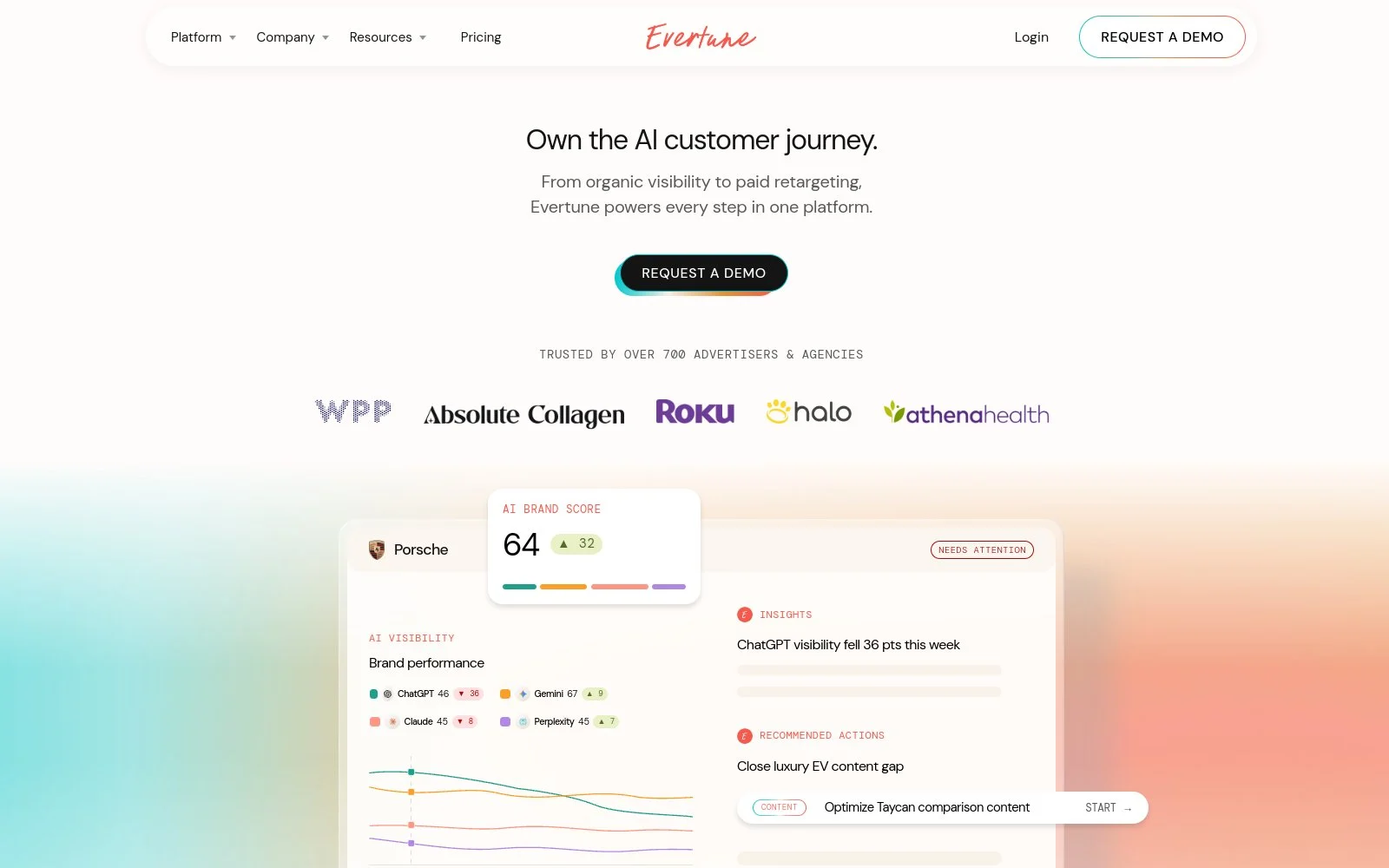
Best for: Brands and agencies that need statistically sampled AI visibility measurement plus content and ad activation
- Samples every prompt 100 times per model across 11+ AI models, including ChatGPT, Claude, Gemini, DeepSeek and Meta AI.
- EverPanel draws prompts from over 150 million real AI user conversations, so tracking mirrors how consumers actually ask.
- Pro plan lists 100,000 tracked prompts at $800/mo with daily tracking and 25 AI-optimized articles per month.
- Named a Notable Vendor in the Forrester Answer Engine Optimization Technologies Landscape, Q3 2026.
Limitation: No public SOC 2, ISO 27001 or GDPR attestation, and no verified G2, Capterra or TrustRadius reviews yet.
Otterly.AI
Best for: Budget-conscious brands and small to mid-sized businesses
- Daily tracking across key engines (Google AI Overviews, ChatGPT, Perplexity, Microsoft Copilot)
- Affordable entry point with free trial
- Easy to use
- Integrates with Semrush App Center
- Published pricing from $29 a month for 15 prompts to $489 for 400, with enterprise from $1,000 a month
Limitation: Limited features vs enterprise platforms; Google AI Mode and Gemini are add-ons; no conversation data or brand sentiment analysis.
Similarweb
Best for: Multi-channel marketers and those needing side-by-side SEO and GEO tracking
- Combines SEO and GEO data to identify keywords + top prompts driving traffic
- Traffic distribution reports by AI channels and GA4-type referral reporting from AI chatbots
- Analyzes top sources for topics and identifies overall topic themes
- Listed on the NYSE as SMWB, reporting $77.2 million in Q2 2026 revenue, up 9 percent year over year
Limitation: No conversation data or brand sentiment analysis; requires contacting sales for pricing and demo.
Semrush
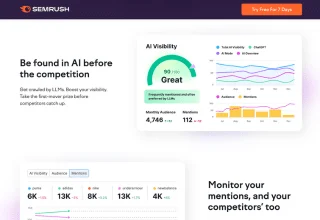
Best for: Existing Semrush users who want to integrate AI visibility into their current SEO workflow
- AI Toolkit integrated with Semrush plus site audit for AI readiness/opportunities
- Strategic recommendations and action items with an extensive prompt database (180M+)
- Tracks ChatGPT, Google AI, Gemini, Perplexity, with Zapier integrations for workflow automation
- The AI Toolkit is a $99 per month per domain add-on that requires an active Semrush subscription
- Acquired by Adobe in April 2026, which now sells it alongside Adobe LLM Optimizer within its CX Enterprise platform
Limitation: Charges for more users; no AI crawler visibility analysis; Claude integration “coming soon” but not yet available.
What the Data Shows That Vendor Pages Do Not
Three things our own scoring data says about this category that you will not find on a product page.
The category sells you an audit and will not promise to be awake. Every tool here asks to be wired into reporting that other people read. Four of the ten publish a confirmed SOC 2 report. Two more assert one without naming an auditor or publishing an audit window, and four do not claim it at all. Not one of the ten publishes a contractual uptime commitment with service credits. That pairing is worth pausing on: this category will show you an audit of how it handles your data, and will not commit to being available on the morning you need the number. If these figures are going into a board deck, ask for the availability terms in writing before you ask about features.
Review volume points the opposite way from the rankings. The two most-reviewed products in this list, Semrush and Similarweb, are the two ranked last. The eight above them carry almost no independent reviews between them. Before reading that as a warning, look at what those counts measure. Both are whole-suite review histories built over a decade of selling SEO software, not verdicts on the AI visibility feature you would actually be buying. Semrush’s AI Toolkit is a $99 per month per domain add-on that requires an active Semrush subscription underneath it. Screening this category by review count ranks parent companies by age, not products by quality, and it would steer you to the bottom of this list.
The capital gap opened up since our last update. Profound announced a $180 million Series D on September 15, 2026 at a $1.8 billion valuation, co-led by Sequoia Capital and Kleiner Perkins, and states it now serves more than 1,000 enterprise brands and over a third of the Fortune 100. That matters less for the feature list than for survival odds. Two of the ten on this page have already been acquired, Scrunch AI by Sitecore in June 2026 and Semrush by Adobe in April 2026, and in a category this young, which vendors are still independent in two years is a real part of the decision rather than a footnote to it.
Side-by-Side Comparison
Summary of where each AI Visibility Tools tends to fit best.
| Platform | Best For | Key Strength | Primary Limitation | Score |
|---|---|---|---|---|
| Profound | Enterprise, regulated industries, multilingual content | Comprehensive AI-engine tracking with GA4 attribution, compliance (SOC 2 Type II / HIPAA), and live visibility snapshots. | High price point, complex setup, visibility only into tracked prompts. | 96 |
| Peec AI | Agencies and in-house teams seeking smart suggestions and competitor tracking | Smart prompt/competitor suggestions plus shareable “Pitch Workspaces” and a Looker Studio connector. | Lacks deep actionable insights/trend data; baseline plans track only ChatGPT, Perplexity, and Google AI Overviews (more engines cost extra). | 92 |
| AthenaHQ | SEO agencies and mid-market teams focused on conversions and comprehensive analytics | Tracks brand visibility + conversions with comprehensive web analytics and unlimited seats across plans. | Lacks advanced enterprise security controls; newer tool with fewer long-term reviews. | 88 |
| AirPulse | B2B teams that want AI answers published and verified, not only tracked | Measurement and remediation in one loop: drafts written from the sources engines cite, published with schema, then re-audited live, plus AI crawler and agent log analytics. | Gemini is Enterprise-only and Google AI starts at the $179 Growth tier; tracked prompts are capped by plan; no revenue attribution; a claimed 4.9/5 G2 rating matches neither figure on its own G2 listing, which shows 4.8 from three reviews on the category page and 5.0 on the product page. | 87 |
| ZipTie | Teams requiring deep technical analysis and granular reporting of GEO data | Granular filtering (URL/query/platform), AI Success Score, GEO indexation audits, and in-platform optimization suggestions. | No conversation data; only tracks Google AI Overviews, ChatGPT, and Perplexity (no add-ons for more engines). | 86 |
| Scrunch AI | Huge enterprise companies needing actionable insights for content optimization | AI-driven optimization action items, citation/trend monitoring, and AXP (AI Agent Experience Platform) in beta. | Outdated website design; no self-service option (requires demo); enterprise-focused and pricing can be high. | 85 |
| Evertune | Statistically rigorous AI brand measurement | 100x prompt sampling across 11+ models | No public SOC 2, ISO 27001 or GDPR attestation, and no verified G2, Capterra or TrustRadius reviews yet. | 85 |
| Otterly.AI | Budget-conscious brands and small to mid-sized businesses | Affordable daily tracking across major engines with a free trial and Semrush App Center integration. | Limited features vs enterprise platforms; Google AI Mode and Gemini are add-ons; no conversation data or brand sentiment analysis. | 84 |
| Similarweb | Multi-channel marketers needing side-by-side SEO and GEO tracking | Combines SEO + GEO, identifies traffic-driving keywords/prompts, and reports AI referral traffic in GA4-type views. | No conversation data or brand sentiment analysis; requires contacting sales for pricing and demo. | 83 |
| Semrush | Existing Semrush users who want AI visibility inside their current SEO workflow | AI Toolkit + AI readiness audit, strategic recommendations, large prompt database, and Zapier integrations. | Charges for more users; no AI crawler visibility analysis; Claude integration “coming soon” but not yet available. | 82 |
How Mktg.Tech Evaluated Each AI Visibility Tool
We used our 7-Point Evaluation Framework™, weighted for what matters most to Marketers & SEO Professionals.
Scope & Breadth
AI Engine Coverage – Breadth of supported AI platforms, including ChatGPT, Google AI Overviews / Mode, Perplexity, Gemini, Copilot, and emerging engines.
Quality & Reliability
Data Depth & Accuracy – Granularity of tracking (prompt, query, URL, citation), freshness of data, and ability to reflect real user AI interactions.
Utility & Output
Actionability & Optimization – Strength of recommendations, content optimization guidance, AEO/GEO scoring, and clarity on what to change to improve AI visibility.
Communication & Integration
Reporting & Shareability – Dashboards, exports, client-ready reports, integrations (GA4, Looker Studio), and ease of sharing insights with stakeholders.
Operational Excellence
Scalability & Automation – Ability to manage multiple brands, markets, or clients with automation, workflows, alerts, and repeatable processes.
Trust & Versatility
Security & Compliance – Enterprise readiness including SOC 2, HIPAA, data handling controls, and suitability for regulated or risk-sensitive industries.
Evidence & Impact
Strategic Insight & Proof – Clarity of methodology, visibility trends over time, benchmarking against competitors, and evidence tying AI visibility to business impact.
How We Scored Each AI Visibility Tool
Data Sources Used
- Official tool websites and feature documentation:
- Product demos, walkthroughs, and published screenshots:
- Pricing pages or disclosed entry-level plans:
- Public case studies, examples, and methodology explanations:
- Third-party reviews and commentary (where available):
- Platform documentation (dashboards, reports, integrations, APIs):
- Public announcements, changelogs, and product updates:
Evaluation Filters
- Offer AI visibility, GEO, or LLM tracking as a core product capability:
- Track brand presence across AI-powered search engines or LLMs:
- Provide repeatable, structured data outputs (dashboards, reports, or exports):
- Demonstrate an active, maintained product with ongoing development:
- Serve professional marketers, agencies, or in-house teams:
What’s Inside the Download
How the Framework Is Weighted
| Criteria | Weight | Relative Emphasis |
|---|---|---|
| Scope & Breadth | 20% | |
| Quality & Reliability | 15% | |
| Utility & Output | 15% | |
| Communication & Integration | 15% | |
| Operational Excellence | 15% | |
| Trust & Versatility | 10% | |
| Evidence & Impact | 10% |
Tool Background & Engagement Profile
| Platform | HQ / Parent Company | Typical Client Size | Primary Focus |
|---|---|---|---|
| Profound | New York, NY | Enterprise, regulated industries | AI-Engine Tracking & Enterprise Compliance |
| Peec AI | Berlin, Germany | Agencies & in-house teams | Prompt Suggestions & Agency Reporting |
| AthenaHQ | San Francisco, CA | SEO agencies, mid-market teams | Conversion Data & Free-Tier Access |
| AirPulse | Covina, CA (Airmeet Inc.) | B2B SaaS & agencies | Measure-Act-Verify Remediation Loop |
| ZipTie | Austin, TX | Technical SEOs, analysts | Granular Technical GEO Analysis |
| Scrunch AI | Salt Lake City, UT (a Sitecore company since June 2026) | Enterprise companies | Actionable Content Optimization |
| Evertune | New York, NY | Mid-market brands, enterprises, agencies | Sampled GEO measurement and activation |
| Otterly.AI | Persenbeug, Austria | Budget-conscious brands & SMBs | Affordable Daily Tracking |
| Similarweb | Tel Aviv, Israel | Multi-channel marketers | Combined SEO + GEO Traffic Intelligence |
| Semrush | Boston, MA (an Adobe company since April 2026) | Existing Semrush users | AI Toolkit Bundled Into Existing SEO Workflows |
Key Capabilities Offered
Profound
- Live AI visibility snapshots across major AI engines
- GA4 attribution and multilingual AI tracking
- Log-level AI crawler data and GEO indexation insights
- Content optimization tools with AEO Content Score
- Enterprise compliance (SOC 2 Type II, HIPAA)
- Workflow automation, prompt fanouts, and agency mode
Peec AI
- Smart AI prompt suggestions and competitor discovery
- Daily AI visibility tracking across supported engines
- “Pitch Workspaces” for client-ready reporting
- Looker Studio connector for live dashboards
- Unlimited countries and generous prompt data per plan
AthenaHQ
- AI-powered GEO tracking for brand visibility
- Conversion tracking tied to AI-driven traffic
- Comprehensive web analytics and reporting
- Unlimited user seats for agency teams
- Free report generation with competitor tracking
AirPulse
- Daily prompt tracking with named, cited and citation-share readouts
- Draft generation from the sources engines already cite, held for approval
- Technical remediation across rendering, schema, sitemaps and llms.txt, re-verified live
- Agent Pulse AI crawler and agent log analytics
- Share of answers benchmarked against named competitors
- Search Console, Google Analytics and WordPress integrations
- Weekly email digest of what moved, engine by engine
- Multi-brand and agency workspaces on Enterprise, with prompts pooled across clients
ZipTie
- Granular AI visibility analysis by URL, query, and platform
- Proprietary AI Success Score for performance benchmarking
- Technical GEO indexation audits
- Identification of influential URLs in AI answers
- In-platform content optimization recommendations
Scrunch AI
- AI-driven insights with clear content optimization actions
- Citation monitoring and AI visibility trend detection
- AXP (AI Agent Experience Platform) for AI-native content delivery
- Enterprise-focused workflows and insights
Evertune
- AI Brand Score and share of voice benchmarking vs competitors
- Prompt tracking across 11+ models with daily, weekly or monthly runs
- Brand attribute and sentiment gap analysis
- Content Studio for AI-optimized articles targeting visibility gaps
- AI ads, retargeting and partner placements via The Trade Desk, Index Exchange, impact.com
Otterly.AI
- Daily AI visibility tracking across major engines
- Affordable plans with a free trial option
- Simple, user-friendly interface for SMBs
- Integration with Semrush App Center
Similarweb
- Combined SEO and GEO visibility tracking
- Identification of AI prompts and keywords driving traffic
- Traffic distribution analysis by AI channel
- GA4-style reporting of AI chatbot referral traffic
Semrush
- AI Toolkit integrated directly into Semrush
- AI readiness site audits and opportunity detection
- Strategic recommendations with extensive prompt database
- Workflow automation via Zapier integrations
Final Takeaway From Mktg.Tech
Across all evaluated sources and weighted performance criteria, Profound ranks as the strongest overall AI visibility platform for 2026, driven by its depth of AI engine coverage, enterprise-grade data access, compliance readiness, and ability to tie AI visibility directly to measurable business impact.
That said, the other tools included in this analysis remain highly valuable depending on team size, budget, technical requirements, and reporting needs. The most important factor is selecting a platform that aligns with how your organization measures success, whether that’s executive reporting, content optimization, competitive benchmarking, or real-time monitoring. Teams that want to act on those findings rather than only measure them should read our generative engine optimization tools ranking.
Editorial Independence & About Mktg.Tech
About This Research
This report was independently produced by the Mktg.Tech Research & Insights team. Rankings are based on publicly available information, platform capabilities, and structured editorial evaluation. No vendor included in this analysis paid for placement, ranking influence, or editorial consideration. Rankings will be reviewed and updated on a quarterly basis as AI platforms, pricing models, supported engines, and feature sets continue to evolve.
Share Your 2026 Recognition
The companies featured in Mktg.Tech’s Best AI Visibility Tools of 2026 are invited to display this official badge on their website, documentation, or marketing materials. For transparency and verification, the badge should link back to the official report.
Use of this badge is intended for platforms included in the 2026 report and signifies verified inclusion.
How to Choose the Right AI Visibility Tools
Choosing an AI visibility solution is less about finding the most feature-packed tool and more about understanding how accurately it measures your brand’s presence across AI-powered search experiences. The best AI visibility platforms help you understand where, how, and why your brand appears in AI answers, giving you actionable insights instead of vanity metrics.
As AI search and generative answers become more common, visibility is no longer just about rankings: it’s about representation, citation, and inclusion in AI-driven discovery.
1. Look for AI-First Data Collection and Tracking
Not all tools labeled “AI visibility” are built specifically for modern AI search environments. A strong AI visibility solution should be designed around how large language models and AI search tools actually surface information, not retrofitted from traditional SEO platforms. Things to look for include:
- Tracking across multiple AI platforms and LLMs:
- Clear identification of when and where your brand is mentioned or cited:
- Consistent, repeatable monitoring rather than one-off snapshots:
2. Evaluate the Depth of Visibility Insights
AI visibility goes beyond knowing if your brand appears: it’s about understanding context, frequency, and competitive presence. As AI answers become more nuanced, shallow tracking provides limited value. Look for solutions that analyze:
- Brand mentions vs. direct citations:
- Prompt-level visibility across different query types:
- Competitive comparisons within AI responses:
- Topic and entity associations tied to your brand:
3. Reporting and Clarity Matter More Than Raw Data
AI visibility data can quickly become overwhelming without proper interpretation. The best platforms translate complex AI outputs into clear, decision-ready insights. Strong AI visibility reporting typically includes:
- Easy-to-understand visibility summaries:
- Clear explanations of why brands appear (or don’t) in AI responses:
- Trends over time rather than isolated data points:
- Visualizations that help teams explain AI visibility to stakeholders:
4. Understand Methodology, Not Just Features
AI visibility tools vary widely in how they collect and interpret data. Some rely on limited prompts or partial sampling, while others offer broader, more systematic coverage. When evaluating a solution, consider:
- How prompts are generated and tested:
- Whether visibility tracking is consistent and repeatable:
- How frequently data is refreshed:
- Whether the methodology reflects real-world AI usage:
5. Watch for Common Red Flags
Not every AI visibility platform delivers meaningful insight. Be cautious of tools that show signs of limited accuracy or inflated value, including:
- Vague explanations of how data is collected:
- Overreliance on isolated prompts or demos:
- Metrics that don’t explain why visibility exists:
- Dashboards filled with numbers but no interpretation:
- No way to compare brand visibility against competitors:
Final Takeaway
The right AI visibility solution should help you understand and improve how AI systems represent your brand, not just report surface-level mentions. Prioritize platforms that offer:
- AI-first tracking across multiple models:
- Deep, contextual visibility insights:
- Clear, stakeholder-ready reporting:
- Transparent methodologies:
- Actionable data that supports content and brand strategy:
As AI continues to reshape search and discovery, AI visibility isn’t optional: it’s a critical layer of understanding how your brand is being surfaced, referenced, and trusted by modern AI systems.
Frequently Asked Questions
What are the best AI visibility tools in 2026?
Profound ranks #1 in our 2026 evaluation with a score of 96 out of 100. It is best for enterprise, regulated industries, multilingual content.
How many AI visibility tools did Mktg.Tech evaluate?
We evaluated and scored 10 AI visibility tools for this ranking. Each one was assessed against the same 7-Point Evaluation Framework and scored out of 100, then ordered by final score.
How does Mktg.Tech score AI visibility tools?
Every entrant is measured against seven weighted categories: Scope & Breadth (20%), Quality & Reliability (15%), Utility & Output (15%), Communication & Integration (15%), Operational Excellence (15%), Trust & Versatility (10%), and Evidence & Impact (10%). The weights total 100%, and the resulting score determines each platform’s rank.
Which AI visibility tool is the best alternative to Profound?
Peec AI ranks #2 with a score of 92 out of 100 and leads the Agencies category, making it the strongest alternative for teams whose priorities differ from the overall winner.
Are these rankings sponsored or paid placements?
No. No vendor paid for placement, ranking influence, or editorial consideration. Rankings are based on publicly available information and structured evaluation, and are reviewed and refreshed on a quarterly basis.