An Independent Review for Brand & Creative Operations Teams
The AI shift has redefined digital asset management in 2026. Moving beyond folder trees and manual tagging, these platforms now tag, describe and find assets with AI, push approved renditions straight to websites and commerce channels, and expose the library to AI assistants through APIs and MCP servers. This report provides a structured comparison of the leading digital asset management software, with Bynder leading the market, to help brand and creative operations teams select the right platform for their specific needs. It spans enterprise DAMs, regulated and media-heavy libraries, brand-led portals and developer-first media platforms, because the DAM sits upstream of everything else: the AI brand management tools that check content and the headless CMS platforms that publish it both depend on a clean, governed library.
Bynder
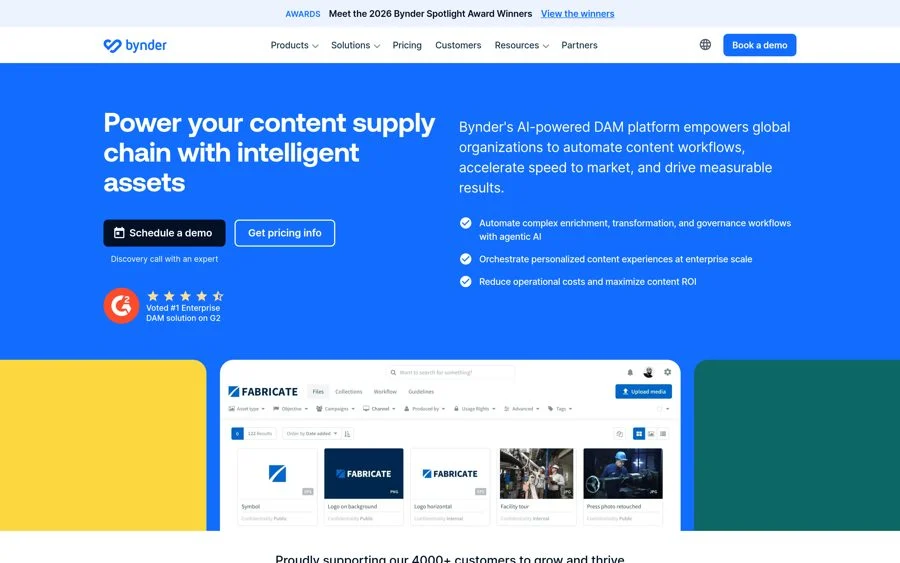
Best for: Mid-market and enterprise brand and creative ops teams that need one AI-searchable library feeding every channel, from websites to sales and retail partners.
- Rated 4.5/5 on Capterra across 228 reviews, and Bynder claims 4,000+ brand customers and 1.7M+ users.
- Named a Leader in the Forrester Wave for DAM, Q1 2026, with top possible scores on AI, Search and Asset Delivery.
- AI auto-tagging plus natural language and similarity search keep huge libraries findable; Fluidra cut search time 80%.
- Dynamic Asset Transformation crops, resizes and converts one master file to WebP on the fly through a global CDN.
Limitation: Pricing is quote-only and modular, with third-party Vendr data putting the median contract near $41,800 a year, and reviewers report a steep setup curve for admins and Brand Portal owners.
Aprimo
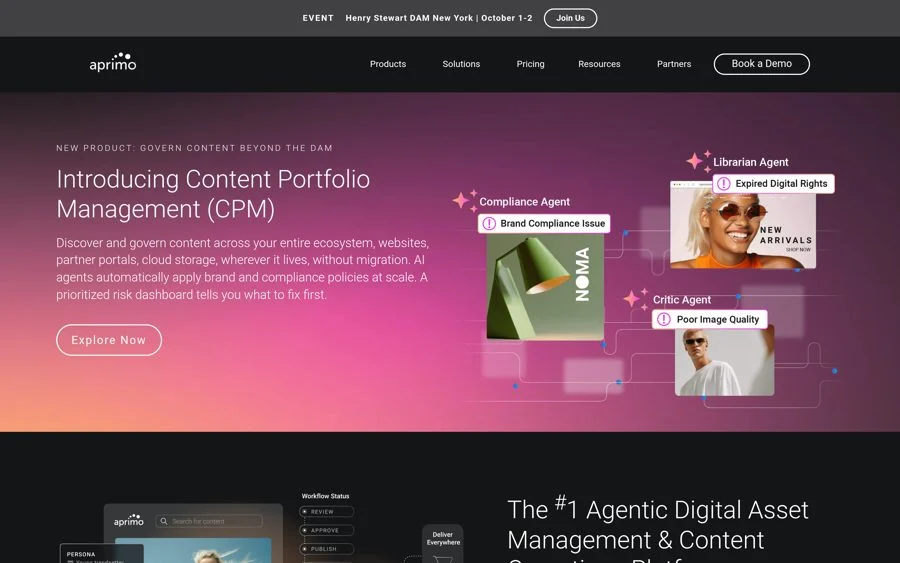
Best for: Enterprise brand and creative operations teams in regulated, high-volume industries that need an AI-governed DAM with rights, compliance review and channel delivery built in.
- A Leader in the 2025 Gartner Magic Quadrant for DAM, placed furthest on Ability to Execute, and in every edition.
- Earned the top Current Offering score of any vendor, 4.38/5, in the Forrester Wave for DAM Systems, Q1 2026.
- Librarian Agents write tags, captions and predictive metadata, and Aprimo reports 17 million agentic actions in a year.
- Brand portals, rights management, CDN public links and on-the-fly renditions push approved assets straight to channels.
Limitation: Aprimo is quote-only and enterprise-priced, with third-party Vendr data putting the median contract near $50,000 a year, and reviewers flag a steep learning curve that calls for real training time.
Adobe Experience Manager Assets
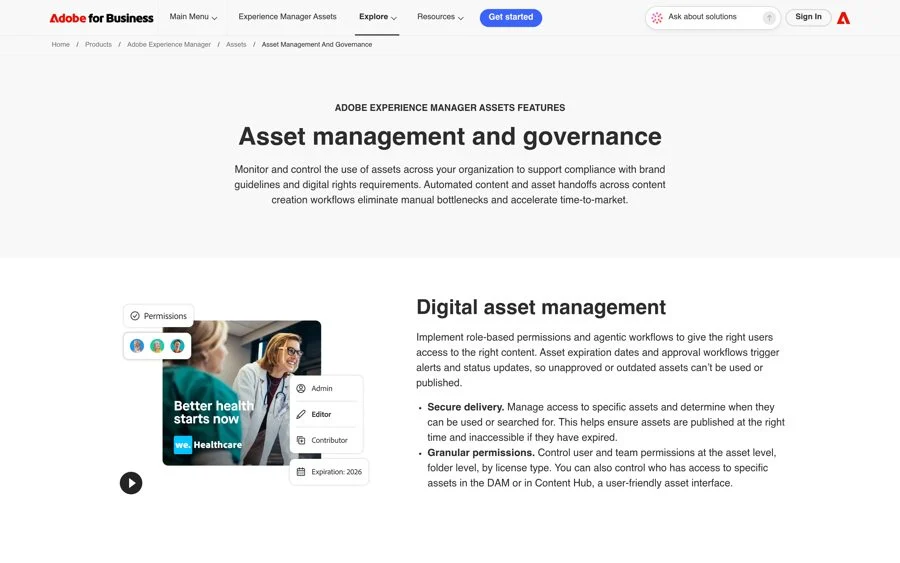
Best for: Large enterprises already invested in Adobe Creative Cloud, Workfront, or AEM Sites that need one governed asset system feeding web, commerce, and partner channels at global scale.
- Named a Leader in both the 2025 Gartner Magic Quadrant for DAM and the Forrester Wave for DAM Systems, Q1 2026.
- Dynamic Media renders and delivers optimized images and video, with Smart Crop and adaptive streaming via CDN.
- Content Hub gives agencies and partners self-service access to approved assets, with 250 users bundled in Ultimate.
- Native ties to Creative Cloud, Workfront, Express, and Figma keep creation, approval, and delivery in one loop.
Limitation: Quote-only pricing, long implementations, and a reliance on certified AEM developers put it out of reach for most mid-market teams.
Orange Logic
Best for: Large enterprises with heavy video, rights-managed, or archival libraries that need a highly configurable DAM and high-touch support.
- Named a Leader in both the 2025 Gartner Magic Quadrant for DAM and the Forrester Wave for DAM Systems, Q1 2026.
- Rated 4.8/5 on Capterra across 10 reviews, with buyers praising support, batch editing and video proxy workflows.
- Built-in digital rights management handles license expiry, embargoes and dynamic watermarking without add-on tools.
- Proven at scale: Pearson serves 70 million monthly video plays and peaks of 40,000 API calls per minute from it.
Limitation: Pricing starts around $60,000 per year and implementations are long and complex, which puts it out of reach for small brand teams.
Frontify
Best for: Mid-market and enterprise brand teams that want their asset library, brand guidelines and templates governed in one portal.
- Rated 4.8/5 on Capterra across 82 reviews, with ease of use and customer service both scored 4.8 by users.
- AI tags new uploads automatically, and teams can search the library by keyword, image or plain natural language.
- CDN embedding pushes approved asset updates live to websites and apps, with no re-uploading after each change.
- Connectors for Adobe Creative Cloud, Figma, Canva, Microsoft 365 and 14 CMS platforms place approved files in tools.
Limitation: Pricing is quote-only on a monthly active user model that reviewers find hard to predict, and Capterra reviewers report portal performance lag and limited page versioning.
Cloudinary
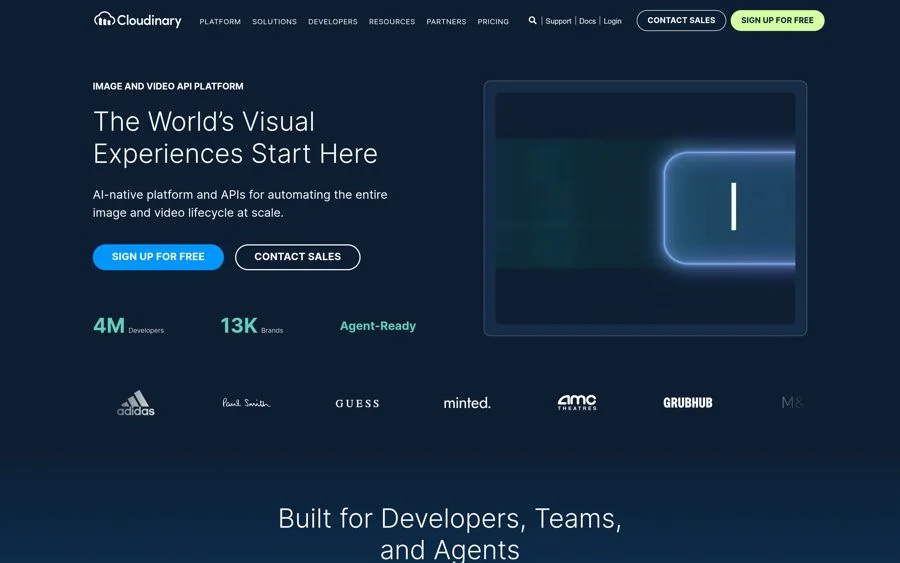
Best for: Digital and ecommerce teams that need a DAM wired directly into automated image and video delivery across web, app, and commerce channels.
- Cloudinary Assets pairs a full DAM with URL-based image and video transformation and CDN delivery in one platform.
- Rated 4.7/5 on Capterra across 85 reviews, and Cloudinary says 13,000 brands and 4M developers use the platform.
- AI agents handle taxonomy, natural-language search, and moderation, alongside generative fill, crop, and restore.
- Named a Visionary in Gartner’s DAM Magic Quadrant and a Leader in the 2024 IDC MarketScape for Intelligent DAM.
Limitation: Full DAM is enterprise quote-only and credit-based billing can climb quickly with video-heavy usage, and reviewers call the admin UI dated for nontechnical users.
Acquia DAM
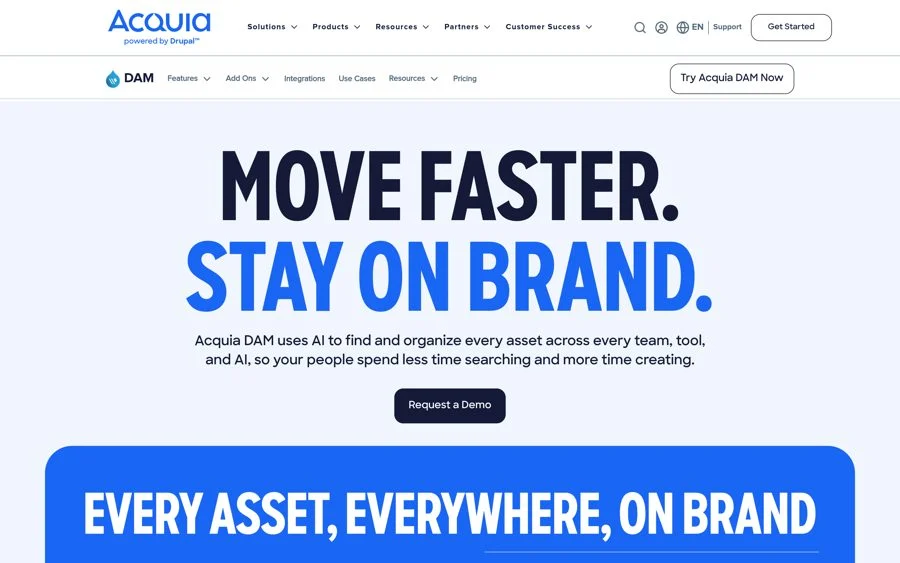
Best for: Mid-market and enterprise brand and creative ops teams that need governed asset distribution through portals, deep metadata, and a wide integration catalog, especially those already on Drupal or Acquia’s DXP.
- Rated 4.4/5 on Capterra across 323 reviews, with reviewers praising its centralized global asset distribution.
- Nearly 300 integrations, including Adobe Creative Cloud, Shopify, Salesforce, and Drupal, plus an open REST API.
- Branded portals and microsites let teams share curated asset sets with partners, agencies, and regional markets.
- AI auto-tagging, alt text, duplicate detection, and a native MCP server connect the library to AI assistants.
Limitation: Reviewers repeatedly flag slow page loads and inconsistent search results, and pricing is quote-only with no published tiers.
Brandfolder
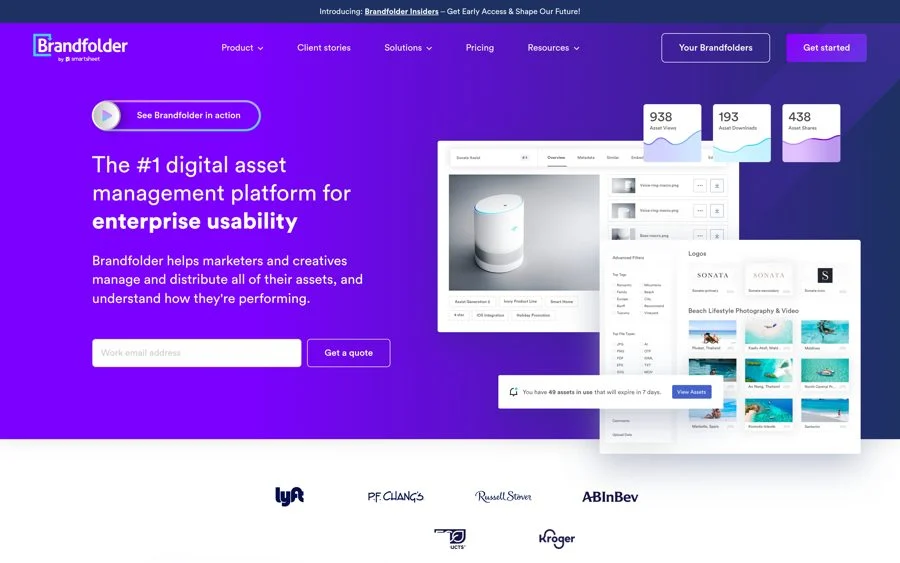
Best for: Marketing and brand teams, especially existing Smartsheet customers, that need an easy, analytics-rich hub to share approved assets with internal teams, partners and agencies.
- Rated 4.7/5 on Capterra across 453 reviews, with users praising its intuitive interface and fast search.
- Smart CDN and branded portals deliver embeddable, always-current assets to partners, agencies and websites.
- Native Smartsheet integration links content planning, creative review and delivery in one connected workflow.
- Content Automation templates let non-designers produce on-brand pieces; ANU reports 19,457 design hours saved.
Limitation: Pricing is quote-only and steep for small teams, and some reviewers report slow previews on large files plus rigid annual contracts.
Canto
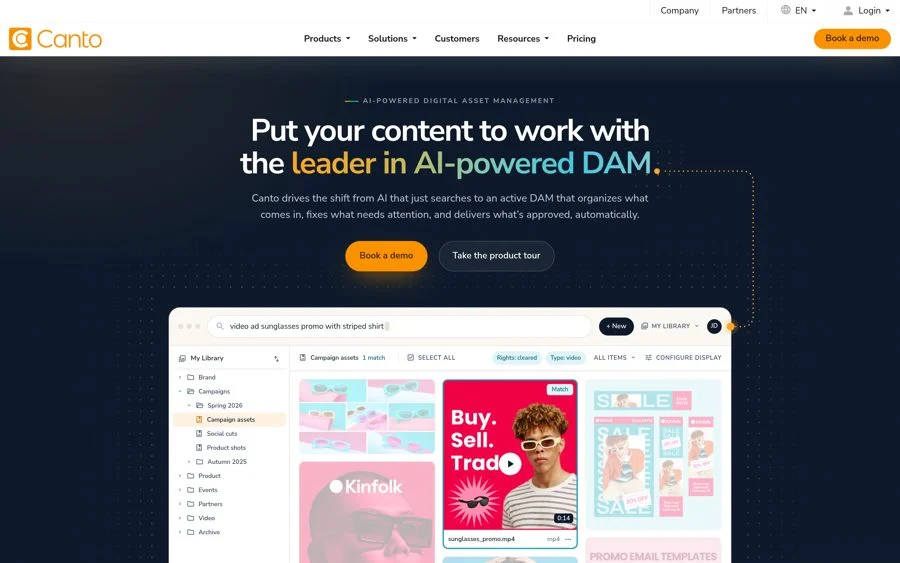
Best for: Brand and creative teams at growing mid-market companies that want a visual, easy-to-adopt DAM with portals, approvals and product content, deployed without a heavy implementation project.
- Rated 4.5/5 on Capterra across 686 verified reviews, with users praising visual organization and fast search.
- Approval Hub, Brand Studio templates and AI Portals keep review, on-brand creation and sharing inside one library.
- DAM for Products adds PIM-style product data and catalogs, with Shopify and Amazon connections for commerce teams.
- Holds SOC 2 Type 2 and ISO 27001:2022 attestations, plus HIPAA, GDPR and TX-RAMP listings in its public Trust Center.
Limitation: Pricing is quote-only and reviewers often call it expensive, while large-file uploads and search consistency draw recurring complaints.
MediaValet
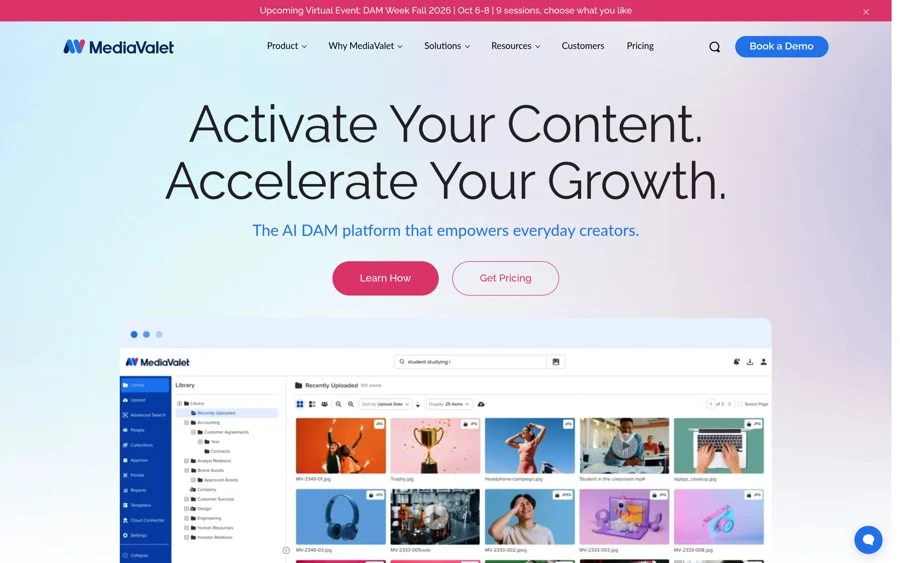
Best for: Mid-market and enterprise brand teams that want an unlimited-user, Azure-hosted asset library with strong governance and support.
- Pricing includes unlimited users with no per-seat fees, so whole organizations and partners can access the library.
- Rated 4.6/5 on Capterra across about 150 verified reviews, with customer service scored 4.6 and value scored 4.5.
- Runs on Microsoft Azure with SOC 2 Type II and ISO 27001 audits completed in 2024, plus SSO, MFA and watermarking.
- Native connectors for Adobe Creative Cloud, Canva, SharePoint, Wrike and Okta keep assets inside existing workflows.
Limitation: Reviewers flag a dated interface, a weak mobile experience and clunky version handling, and no pricing is published.
Side-by-Side Comparison
Summary of where each Digital Asset Management Software tends to fit best.
| Platform | Best For | Key Strength | Primary Limitation | Score |
|---|---|---|---|---|
| Bynder | Enterprises consolidating assets into one AI-searchable library | AI search plus CDN delivery of on-the-fly image renditions | Pricing is quote-only and modular, with third-party Vendr data putting the median contract near $41,800 a year, and reviewers report a steep setup curve for admins and Brand Portal owners. | 94 |
| Aprimo | Regulated enterprises governing brand assets at global scale | Gartner DAM MQ Leader, top Forrester DAM Current Offering | Aprimo is quote-only and enterprise-priced, with third-party Vendr data putting the median contract near $50,000 a year, and reviewers flag a steep learning curve that calls for real training time. | 93 |
| Adobe Experience Manager Assets | Adobe-centric enterprises with heavy omnichannel delivery | Dynamic Media delivery plus deep Creative Cloud integration | Quote-only pricing, long implementations, and a reliance on certified AEM developers put it out of reach for most mid-market teams. | 91 |
| Orange Logic | Enterprises with large video, archive and rights-managed libraries | Gartner and Forrester Leader with native DRM and deep configurability | Pricing starts around $60,000 per year and implementations are long and complex, which puts it out of reach for small brand teams. | 89 |
| Frontify | Brand teams that want DAM, guidelines and templates in one portal | Assets sit next to the guidelines that govern their use | Pricing is quote-only on a monthly active user model that reviewers find hard to predict, and Capterra reviewers report portal performance lag and limited page versioning. | 85 |
| Cloudinary | Ecommerce and digital teams pairing DAM with automated delivery | DAM plus real-time image and video APIs and CDN in one stack | Full DAM is enterprise quote-only and credit-based billing can climb quickly with video-heavy usage, and reviewers call the admin UI dated for nontechnical users. | 84 |
| Acquia DAM | Brand teams distributing governed assets to partners via portals | Configurable metadata, branded portals, and nearly 300 integrations | Reviewers repeatedly flag slow page loads and inconsistent search results, and pricing is quote-only with no published tiers. | 83 |
| Brandfolder | Brand teams sharing assets widely, especially Smartsheet shops | Usability, Smart CDN delivery and asset analytics | Pricing is quote-only and steep for small teams, and some reviewers report slow previews on large files plus rigid annual contracts. | 81 |
| Canto | Mid-market brand teams wanting fast, low-lift DAM adoption | Visual library, portals and approvals that teams adopt quickly | Pricing is quote-only and reviewers often call it expensive, while large-file uploads and search consistency draw recurring complaints. | 79 |
| MediaValet | Enterprise teams wanting unlimited users and Azure-grade governance | Unlimited users plus SOC 2 Type II, ISO 27001 and strong support | Reviewers flag a dated interface, a weak mobile experience and clunky version handling, and no pricing is published. | 76 |
How Mktg.Tech Evaluated Each Digital Asset Management Platform
We used our 7-Point Evaluation Framework™, weighted for what matters most to Brand & Creative Operations Teams.
Scope & Breadth
Asset Lifecycle Coverage – how much of the asset lifecycle one platform covers on its own, from ingest, rights and versioning through review, approval, templating, distribution and archive, across images, video, documents and 3D.
Quality & Reliability
Search & Metadata Accuracy – how reliably people find the right approved asset, through taxonomy and metadata controls, AI auto-tagging, visual and semantic search, and duplicate and version handling that hold up across large libraries.
Utility & Output
Distribution & Delivery – whether approved assets actually reach the places they are used, through brand portals, share links, renditions, on-the-fly transformation and CDN delivery to web, commerce and partner channels.
Communication & Integration
Ecosystem Integrations – native connectors into the creative suite, CMS, PIM, commerce, project management and office tools, plus open APIs, webhooks and MCP access that let the library feed the rest of the stack.
Operational Excellence
Workflow & Scale – review and approval workflows, automation, multi-brand and multi-region permissions, and performance with millions of assets, so creative operations teams can scale without adding headcount.
Trust & Versatility
Security & Governance – SOC 2 and ISO 27001 disclosures, SSO and granular permissions, rights and license expiry controls, published uptime SLAs and clear policies on AI training with customer content.
Evidence & Impact
Proven ROI – analyst placements, review-platform depth and named case studies with quantified time, cost or reuse results, weighted toward independently verifiable evidence over vendor claims.
How We Scored Each Digital Asset Management Platform
Data Sources Used
- Official Product & Pricing Pages: Published plan limits, tier prices, storage allowances and AI features read from each vendor’s own live pages, with quote-only pricing recorded as such.
- Product Documentation & Release Notes: Help centers, API references and 2025 and 2026 release notes, checked for general availability rather than beta or roadmap status.
- Independent Review Platforms: Ratings, review counts and recurring themes from G2, Capterra, TrustRadius and Trustpilot, with blocked, missing or tiny listings named rather than averaged away.
- Analyst Evaluations: Gartner Magic Quadrant and Forrester Wave placements for digital asset management, marked confirmed only where a primary or analyst-quoting source was read.
- Security & Trust Centers: SOC 2, ISO 27001, GDPR and HIPAA disclosures and published SLAs, labeled as vendor claims where the underlying report is not public.
- Customer Case Studies: Named deployments with quantified search time, reuse, cost or production results, attributed to the vendor unless independently published.
- Third-Party Pricing Data: Vendr, marketplace and review-site contract estimates for quote-only platforms, always labeled as third-party rather than vendor-confirmed.
Evaluation Filters
- Core DAM Capability: Offer a governed, searchable library of brand and creative assets with metadata, versioning and permissions as a primary product, not as a side feature of file storage or a design tool.
- Active Development: Release meaningful product updates through 2025 and 2026, including AI tagging, search, workflow or integration capabilities in general availability.
- Enterprise & Professional Focus: Serve brand, marketing and creative teams at business scale, with SSO, roles, approvals, documented security practices and a support model beyond a community forum.
- Distribution Beyond the Library: Get approved assets out to websites, commerce, partners and regional teams through portals, integrations or delivery APIs, rather than only storing them.
- Verifiable Footprint: Have a public review history, named customers or analyst coverage that allows claims to be checked against something other than the vendor’s own marketing.
What’s Inside the Download
How the Framework Is Weighted
| Criteria | Weight | Relative Emphasis |
|---|---|---|
| Scope & Breadth | 20% | |
| Quality & Reliability | 15% | |
| Utility & Output | 15% | |
| Communication & Integration | 15% | |
| Operational Excellence | 15% | |
| Trust & Versatility | 10% | |
| Evidence & Impact | 10% |
Tool Background & Engagement Profile
| Platform | HQ / Parent Company | Typical Client Size | Primary Focus |
|---|---|---|---|
| Bynder | Amsterdam, Netherlands (majority owned by Thomas H. Lee Partners since 2022) | Upper mid-market to global enterprise | AI-powered enterprise DAM and delivery |
| Aprimo | Chicago, IL, USA (privately held; owned by Marlin Equity Partners since 2016) | Upper mid-market to large enterprise, strongest in regulated industries | AI-governed enterprise DAM and compliance |
| Adobe Experience Manager Assets | San Jose, USA (Adobe Inc., NASDAQ: ADBE) | Enterprise and large mid-market | Enterprise DAM with dynamic media delivery |
| Orange Logic | Irvine, United States (private; Bregal Sagemount growth investment, 2023) | Large enterprise and upper mid-market | Enterprise DAM, MAM and rights management |
| Frontify | St. Gallen, Switzerland (private, venture-backed) | Mid-market to enterprise global brands | Brand-centric DAM with guidelines |
| Cloudinary | San Jose, California, USA (private, venture-backed; R&D in Petah Tikva, Israel) | Mid-market to enterprise for Assets DAM; free and self-serve tiers for developers and SMBs on the APIs | DAM plus programmable media delivery |
| Acquia DAM | Boston, USA (Acquia, majority-owned by Vista Equity Partners; DAM team rooted in Madison, WI) | Mid-market to large enterprise | Governed brand asset distribution |
| Brandfolder | Bellevue, WA, USA (Smartsheet subsidiary, founded in Denver; Smartsheet owned by Blackstone and Vista since Jan 2025) | Mid-market to enterprise; Capterra reviewer mix 46% small, 30% mid-size, 24% enterprise | Brand asset hub with distribution analytics |
| Canto | Atlanta, USA (private, JMI Equity growth investment 2021) | Small business to mid-market, with some enterprise accounts | Visual DAM plus product content (PIM) |
| MediaValet | Vancouver, Canada (owned by private equity firm STG since April 2024) | Mid-market to enterprise, plus higher education, nonprofits and media | Cloud DAM with unlimited users on Azure |
Key Capabilities Offered
Bynder
- AI auto-tagging and custom taxonomy
- Natural language and similarity search
- Rights management and version control
- Dynamic Asset Transformation via CDN
- Brand portals and curated collections
- 160+ integrations, APIs and SDKs
Aprimo
- Semantic search with AI Librarian Agents for metadata
- Predictive Metadata, smart tagging and video summaries
- Compliance Agents checking claims and brand rules
- Smart Transform renditions, cropping and variants
- Brand portals, DRM and CDN-backed public links
- REST API, integrations marketplace and MCP Server
Adobe Experience Manager Assets
- AI Smart Tags and natural-language search
- Content Hub partner and brand portal
- Dynamic Media with OpenAPI delivery
- Creative Cloud and Figma asset linking
- Workfront approval workflows
- Asset insights and usage reporting
Orange Logic
- Digital and media asset management (DAM + MAM)
- Digital rights management with expiry automation
- Project workflows, reviews and approvals
- Brand portals and secure external sharing
- Agentic AI Studio and AI auto-tagging
- Adobe CC, Figma, SharePoint and Salesforce connectors
Frontify
- AI auto-tagging and natural language search
- License expiry alerts and rights management
- Approval workflows with video and PDF annotation
- CDN asset delivery and format transformation
- Creative, CMS and PIM integrations
- Granular permissions by team, region or partner
Cloudinary
- AI auto-tagging, Taxonomy and Search agents
- Review and approval workflows with versioning
- Branded portals for internal and external users
- On-the-fly image and video transformation via URL
- Multi-CDN optimized delivery (enterprise)
- Connectors for Shopify, Salesforce, Contentful, Akeneo
Acquia DAM
- AI auto-tagging, alt text, and duplicate detection
- Natural language search with configurable metadata
- Branded portals and microsites
- Brand templates and AI Video Creator
- Workflow proofing and rights management
- Asset usage insights and analytics
Brandfolder
- AI auto-tagging, duplicate detection and video AI (Brand Intelligence)
- Smart CDN for embedding and auto-updating web assets
- Branded portals, collections and Brandguide guidelines
- Creative review, approval and markup workflows
- Content Automation templating for on-brand self-service
- Asset analytics plus Insights data connector and open API
Canto
- AI Visual Search and AI metadata tagging
- Approval Hub review and proofing workflows
- Brand Studio templates and brand guidelines
- AI Portals for branded external sharing
- DAM for Products with PIM and catalogs
- 50+ integrations incl. Adobe CC, Figma, Canva, Shopify
MediaValet
- AI auto-tagging and advanced search
- Branded portals for external sharing
- CDN links for web delivery
- Proofing and approval workflows
- Video management and templating
- Usage reporting and analytics
Final Takeaway From Mktg.Tech
Across all evaluated sources and weighted performance criteria, Bynder ranks as the strongest overall digital asset management software for 2026. It leads on the category that carries the most weight here, asset lifecycle coverage, and pairs it with the strongest combination of search and delivery in this group: AI auto-tagging with natural language and similarity search, plus on-the-fly renditions served through a global CDN. Its evidence base is also deep, with a Leader placement in the Forrester Wave for DAM Systems, Q1 2026, 228 Capterra reviews at 4.5/5 and more than 4,000 brand customers.
That does not make it the right answer for every team. Aprimo is the closer fit for regulated enterprises that need rights and compliance review built in, Adobe Experience Manager Assets for organizations already standardized on Adobe, Orange Logic for video-heavy and archival libraries, and Cloudinary for digital teams that want DAM and programmable delivery in one stack. Mid-market teams will often get faster adoption from Brandfolder or Canto. The single most important decision factor is where your assets break down today: findability, approvals, distribution or rights.
Editorial Independence & About Mktg.Tech
About This Research
This report was independently produced by the Mktg.Tech Research & Insights team. Rankings are based on publicly available information, vendor documentation and trust center disclosures, independent review-platform data, analyst placements confirmed against primary sources, and structured evaluation against our 7-Point Evaluation Framework. No vendor included in this analysis paid for placement, ranking influence, or editorial consideration. Rankings will be reviewed and updated on a quarterly basis as digital asset management software, AI tagging and search, and MCP-based integrations continue to evolve.
Share Your 2026 Recognition
The companies featured in Mktg.Tech’s Best Digital Asset Management Software of 2026 are invited to display this official badge on their website, documentation, or marketing materials. For transparency and verification, the badge should link back to the official report.
Use of this badge is intended for platforms included in the 2026 report and signifies verified inclusion.
Frequently Asked Questions
What are the best digital asset management software in 2026?
Bynder ranks #1 in our 2026 evaluation with a score of 94 out of 100. It is best for mid-market and enterprise brand and creative ops teams that need one AI-searchable library feeding every channel, from websites to sales and retail partners.
How many digital asset management software did Mktg.Tech evaluate?
We evaluated and scored 10 digital asset management software for this ranking. Each one was assessed against the same 7-Point Evaluation Framework and scored out of 100, then ordered by final score.
How does Mktg.Tech score digital asset management software?
Every entrant is measured against seven weighted categories: Scope & Breadth (20%), Quality & Reliability (15%), Utility & Output (15%), Communication & Integration (15%), Operational Excellence (15%), Trust & Versatility (10%), and Evidence & Impact (10%). The weights total 100%, and the resulting score determines each platform’s rank.
Which digital asset management software is the best alternative to Bynder?
Aprimo ranks #2 with a score of 93 out of 100 and leads the Regulated DAM category, making it the strongest alternative for teams whose priorities differ from the overall winner.
Are these rankings sponsored or paid placements?
No. No vendor paid for placement, ranking influence, or editorial consideration. Rankings are based on publicly available information and structured evaluation, and are reviewed and refreshed on a quarterly basis.
How to Choose the Right Digital Asset Management Software
Digital asset management in 2026 is less about storage and more about flow. A modern DAM is the governed source of truth for every approved image, video and document, the place where creative work is reviewed and released, and the hub that pushes the right rendition to the website, the store, the sales deck and the partner portal.
AI has changed what good looks like. Auto-tagging and visual search have made large libraries findable without armies of librarians, and agents now draft metadata, check rights and generate variants. The practical question is no longer whether a DAM has AI, but whether its AI makes your own library more accurate, and whether the platform reaches the tools where your teams already work.
1. Define Where Assets Break Down Today
Most DAM projects fail because they solve the wrong bottleneck. Start by naming where time and money actually leak.
- Findability: Do people recreate assets because they cannot find the approved version?
- Review and Approval: Do creative files stall in email threads and inbox sign-off chains?
- Distribution: Do regional teams, partners and retailers get outdated logos and product shots?
- Rights and Expiry: Have licensed images or talent usage rights ever run past their expiry date in market?
2. Test Search on Your Own Library
Vendor demos use tidy libraries. Your library is not tidy, so test search against a real sample.
- AI Auto-Tagging: How accurate are generated tags on your product, people and campaign imagery?
- Visual and Semantic Search: Can users find assets by describing them, or by searching with a similar image?
- Taxonomy Controls: Can admins enforce controlled vocabularies and required fields at upload?
- Duplicates and Versions: Does the platform detect duplicates and keep one current version with full history?
3. Map the Integrations You Will Actually Use
A DAM earns its keep when assets move without downloads and re-uploads. List the systems on both sides of the library.
- Creative Tools: Native panels for Adobe Creative Cloud, Figma and Canva so designers never leave their tools.
- Publishing Systems: Connectors for your CMS, PIM and commerce platform, ideally with live links rather than copies.
- Work Management: Links to project tools so briefs, reviews and final assets stay connected.
- Open Access: Documented APIs, webhooks and MCP support for custom workflows and AI assistants.
4. Plan for Scale and Governance
The DAM that fits 20 users can buckle at 2,000. Check how the platform handles growth before it becomes a migration.
- Permissions Model: Granular roles by brand, region, agency and partner without duplicating libraries.
- Workflow Automation: Configurable review stages, approvals and automated metadata or rights rules.
- Performance at Volume: Proven search and upload speed with millions of assets and large video files.
- Security Posture: SOC 2 Type II, ISO 27001, SSO and a published uptime SLA with service credits.
5. Model the Total Cost and Prove the Return
DAM pricing is rarely published, and storage, users and modules all move the number. Model the full cost before you negotiate.
- Pricing Drivers: Understand whether price scales by users, storage, bandwidth, brands or add-on modules.
- Implementation Cost: Budget for migration, taxonomy design and professional services, often a meaningful share of year one.
- Third-Party Benchmarks: Use marketplace contract data to sanity-check quotes, and ask about multi-year discounts.
- Baseline Metrics: Measure search time, asset reuse and recreation costs before launch so ROI can be proven after.
Final Takeaway
The right digital asset management software should make the approved asset the easiest one to find and use, everywhere your teams work. Prioritize platforms that offer:
- Full Lifecycle Coverage: from ingest and rights through review, distribution and archive.
- Search That Works on Your Content: with AI tagging and visual search tested against your own library.
- Integrations Where Work Happens: including creative tools, the CMS, commerce and open APIs.
- Governance at Scale: with granular permissions, approvals and rights expiry controls.
- Verified Security and Evidence: including SOC 2, ISO 27001 and case studies you can check.
Be skeptical of any ROI figure you cannot reproduce. In this category most case studies are vendor-published, and the strongest signal is a pilot that measures search time and asset reuse on your own library.