An Independent Review for Marketing Operations & RevOps Teams
The AI agent shift has redefined marketing operations in 2026. Moving beyond spreadsheets, ticket queues and one-off scripts bolted onto the marketing automation platform, these platforms now run governed AI agents that triage intake, reconcile spend, clean records, route leads and check content for compliance, with every action logged. This report provides a structured comparison of the leading AI marketing operations platforms, with Aprimo leading the market, to help marketing operations and RevOps teams select the right platform for their specific needs. It spans five layers of the operations stack, from planning and spend to work management, asset production, GTM data and lead routing, because no single vendor owns all of them.
Aprimo
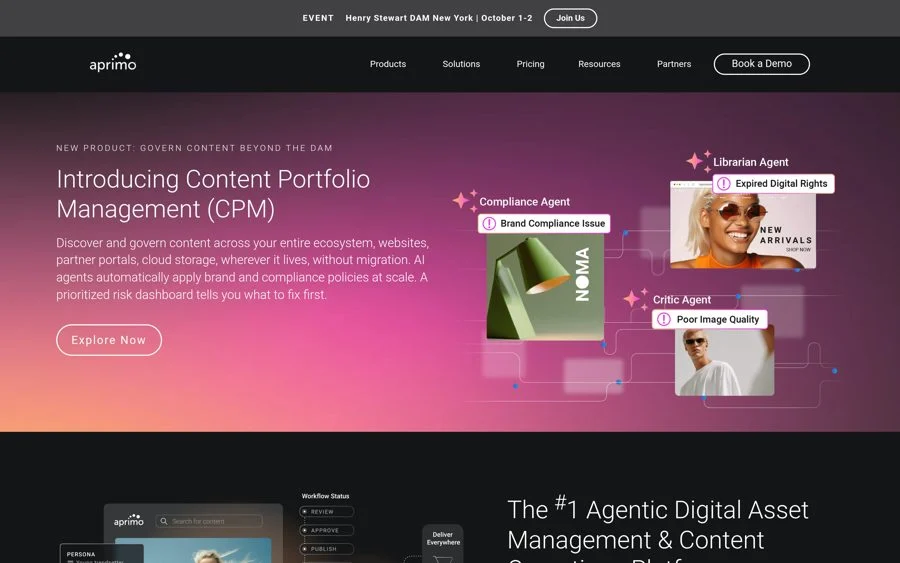
Best for: Enterprise marketing ops and brand teams in regulated, high-volume industries that need planning, spend, workflow, assets and AI compliance checks governed in one platform.
- Named a Leader in the 2025 Gartner Magic Quadrant for Marketing Work Management, placed furthest on Ability to Execute.
- A Leader in the Forrester Wave for DAM Systems, Q1 2026, with the top Current Offering score of any vendor at 4.38/5.
- Five AI agent families handle briefs, taxonomy, brand and regulatory checks and image edits, with human review.
- Plans, budgets, spend, work management, reviews and the DAM run in one platform, plus an MCP Server for corporate LLMs.
Limitation: Aprimo is quote-only and enterprise-priced, with third-party Vendr data putting the median contract near $50,000 a year, and its review-site samples are too small to judge support quality with confidence.
Adobe Workfront
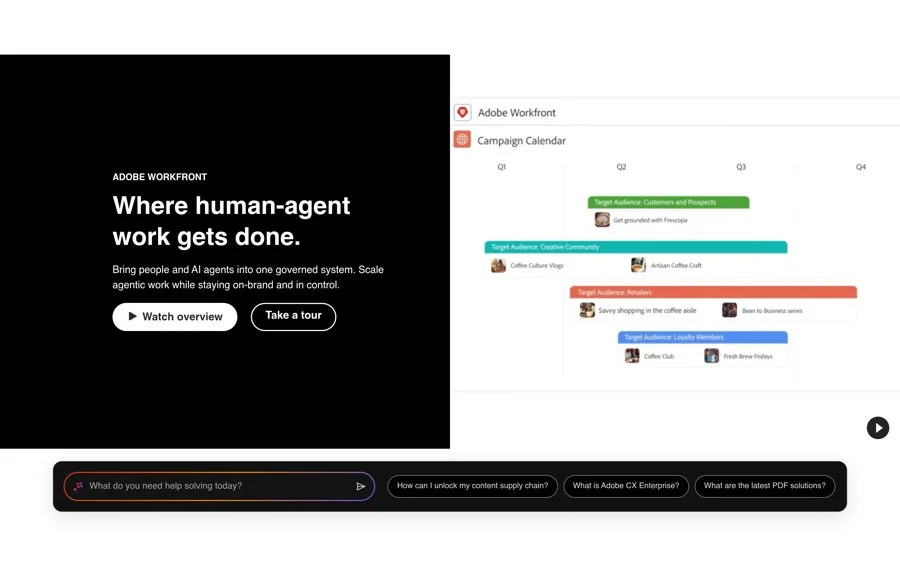
Best for: Enterprise marketing operations leaders who run high-volume campaign and content workflows on the Adobe stack and want planning, approvals and AI agents governed in one system of record.
- Rated 4.1/5 on G2 across 1,234 reviews and 4.4/5 on Capterra across 1,500, the deepest review base among enterprise entrants.
- AI Collaborators, generally available August 2026, let teams assign tasks to AI agents with every step logged for human review.
- Named a Leader in The Forrester Wave: Collaborative Work Management Tools, Q2 2025.
- An MCP server connects Workfront and Planning to Claude, ChatGPT, Copilot and Gemini, and Adobe lists ISO 27001 for the product.
Limitation: Reviewers consistently describe a steep learning curve, a cluttered interface and complex setup, and every tier is quote-only, with advanced Fusion automation reserved for the top package.
Tray.ai
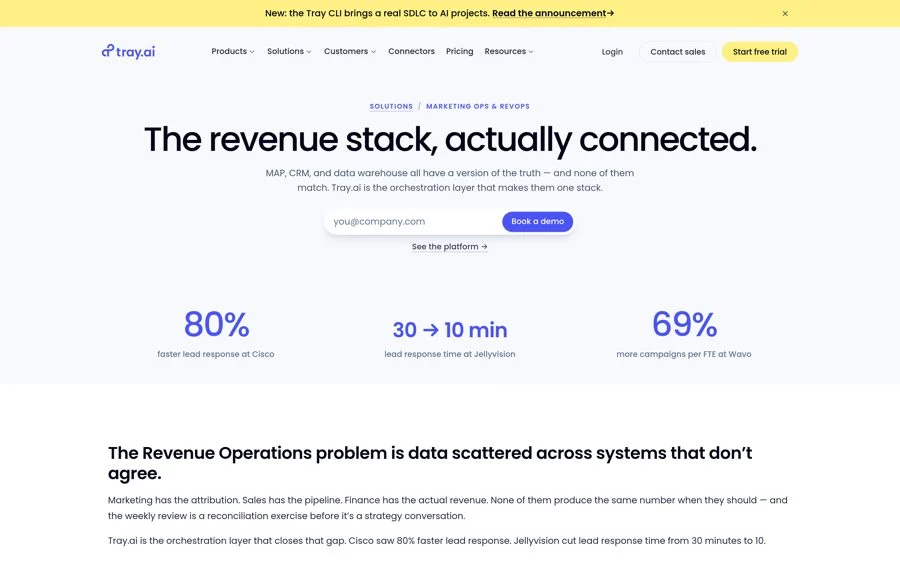
Best for: Mid-market and enterprise marketing ops and RevOps teams that want to orchestrate lead routing, enrichment and AI agents across a complex GTM stack without waiting on engineering sprints.
- Ships 700+ prebuilt connectors, and Agent Gateway exposes them to AI agents as governed MCP tools.
- A Visionary in the 2026 Gartner Magic Quadrant for iPaaS for a third straight year, and a Pioneer for no-code agent builders.
- DocuSign moved from 90% of leads reaching sales in under 10 minutes to 99% in under 3 minutes, a vendor-published result.
- SOC 1 and SOC 2 Type 2 examined by Schellman, with audit trails on every agent action; Capterra rates it 4.9/5 (11 reviews).
Limitation: Pricing is sales-led and task-based with no public list prices, third-party Vendr data puts the median contract near $37,600 a year, and reviewers say costs can climb as workflows grow more complex.
Wrike
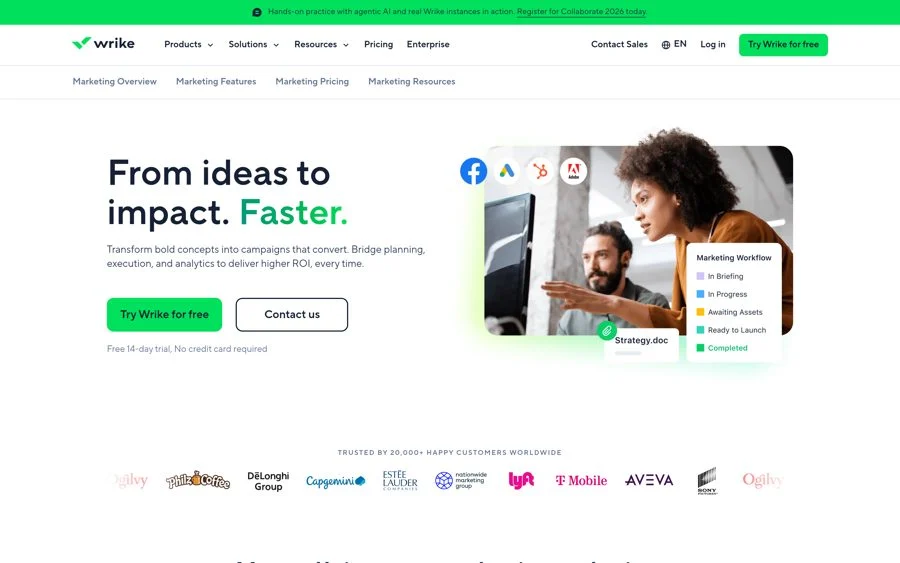
Best for: Marketing and creative operations leaders at mid-market and enterprise companies who need one governed system for campaign intake, proofing, resourcing and AI-automated workflows.
- Used by 20,000+ organizations and rated 4.4/5 on Capterra across 3,041 reviews, the largest verified review base here.
- Customers have run 5.5 million+ AI agent actions, and a no-code conversational agent builder shipped in July 2026.
- The Wrike MCP Server lets Claude, ChatGPT, Copilot and Gemini act on live work data, alongside 400+ integrations.
- Published pricing starts at $10 per user per month on Team and $25 on Business, rare in a quote-driven category.
Limitation: Reviewers often cite a steep learning curve, and the heavier AI agent allowances, integration and two-way sync features sit in sales-quoted top tiers or custom-priced add-ons.
Openprise
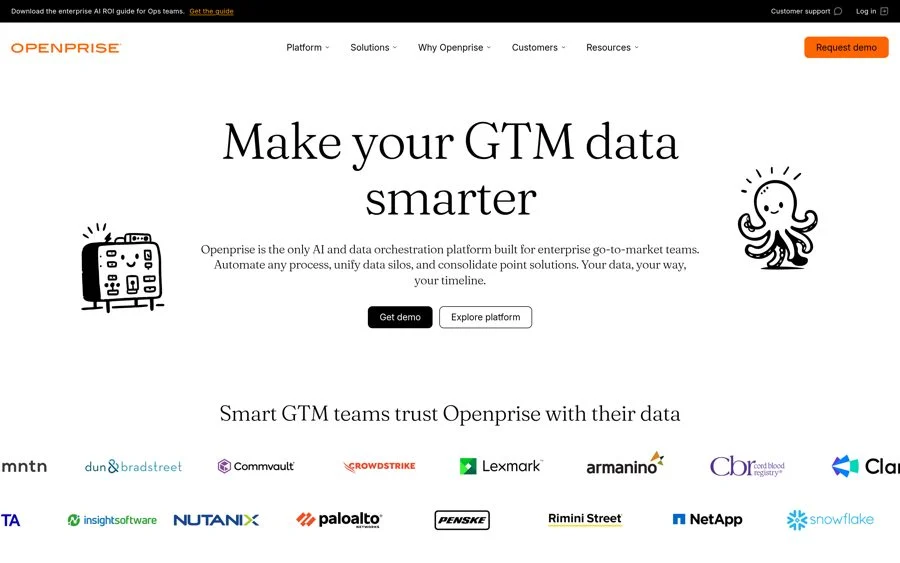
Best for: Enterprise marketing ops and RevOps leaders who need to clean, unify and route GTM data across a multi-vendor stack before activating it with AI agents.
- Ships 400+ prebuilt connectors and serves 200+ enterprises, including CrowdStrike, Nutanix and Zendesk, per the vendor.
- Runs dedupe and enrichment as deterministic rules, which Openprise says cuts agentic AI token costs by up to 80%.
- AI Skills Factory and custom MCPs let agents call governed skills, with a safety layer that validates every write.
- Nutanix consolidated 650,000 CRM accounts to 180,000 and cut routing from 2 days to under 1 hour, a vendor result.
Limitation: It has no built-in B2B contact database and a steep learning curve, and its $35,000-a-year entry price puts it out of reach for small teams.
LeanData

Best for: Enterprise and upper mid-market RevOps teams on Salesforce that handle high inbound volume and complex, multi-object routing, and that have dedicated admin resources.
- Salesforce-native lead-to-account matching and FlowBuilder routing across every object, used by 1,000+ companies.
- AI Inference Nodes place LLM prompts inside routing graphs, keeping every other step rule-based and auditable.
- BookIt scheduling APIs and a beta MCP server let AI SDRs and Agentforce book meetings with routing rules applied.
- Uber cut MQL time-to-assignment 95% and Zoom lifted lead-to-opportunity conversion 54%, per vendor case studies.
Limitation: LeanData is built around Salesforce, so reviewers report a steep setup curve and heavy admin overhead at scale, and it has no built-in contact data or intent signals.
Clay
Best for: RevOps and marketing ops leaders, or dedicated GTM engineers, who want one programmable layer to enrich, score and route account and contact data into the CRM and downstream channels.
- Waterfall enrichment chains 200+ data providers, so a miss on one automatically tries the next.
- Claygent agents, including Navigator browser automation, research accounts on websites that have no API.
- Native Salesforce and HubSpot sync, ad audience syncs and an MCP server make Clay an operational data layer.
- Raised a $115M Series D at a $7.1B valuation in September 2026 and reports 17,000+ customers, including OpenAI.
Limitation: The learning curve is steep and credit use is hard to predict, so teams without a dedicated GTM engineer or RevOps builder can burn budget quickly and take weeks to get productive.
Uptempo
Best for: Enterprise marketing operations and finance-minded marketing leaders who need one governed system of record for plans, budgets, spend and ROI across global teams.
- Used by 625,000+ marketers at 250+ enterprises managing $30B+ in marketing investment, per the vendor.
- OptiMine marketing mix modeling, acquired in August 2025, measures the incremental revenue produced by existing spend.
- Multi-Activity Funding tracks spend to the tactic level and splits invoices across campaigns for faster reconciliation.
- Its trust center lists SOC 1 and SOC 2 Type II, TISAX, GDPR and CCPA; Capterra rates it 4.6/5 across 12 reviews.
Limitation: It is quote-only and complex, TrustRadius reviewers (7.7/10 across 56) describe a steep learning curve, and its Decision Intelligence AI layer was only previewed in June 2026 rather than generally available.
Knak
Best for: Enterprise marketing ops teams running Marketo, Salesforce Marketing Cloud or Eloqua who need to scale on-brand email and landing page production without developers.
- Connects to 40+ platforms, including Marketo Engage, Salesforce Marketing Cloud, Eloqua, Braze and HubSpot.
- Rated 4.8/5 on Capterra across 17 reviews, with 4.9/5 scores for both ease of use and customer service.
- The Knak MCP server and Enterprise API let ChatGPT and Claude generate on-brand assets from approved templates.
- Automated brand, compliance and accessibility checks run before human review, backed by a SOC 2 Type II audit.
Limitation: Knak is a production and governance layer rather than an orchestration or analytics platform, so segmentation and sends still happen in the connected MAP, and Capterra lists quote-only pricing from about $10,000 a year.
Planful for Marketing
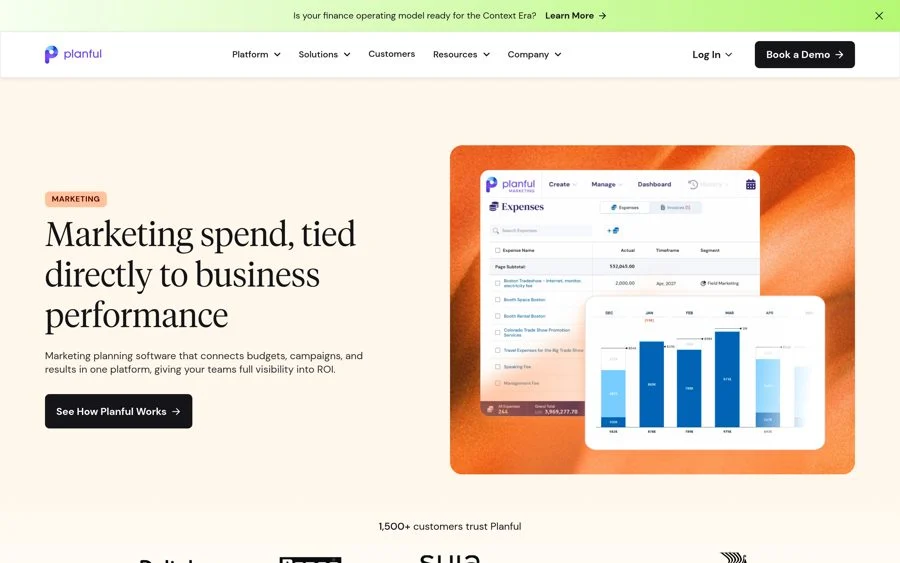
Best for: Marketing ops leaders and CMOs who need to tie marketing plans and budgets to actual spend and ROI in a system finance also trusts.
- Rated 5.0/5 on Capterra from 10 reviews, with ease of use at 4.8 and customer service at 5.0.
- Budgets, campaigns and results share one model with finance, so actual spend updates the plan automatically.
- Native integrations pull spend and results from Google, LinkedIn and Facebook ads and from Salesforce.
- Its parent’s trust center lists ISO 27001:2022, SOC 2 Type 2 and a HIPAA BAA, and Planful reports 1,500+ customers.
Limitation: It covers budgeting, spend and ROI rather than running campaigns, and Planful’s 2025 and 2026 AI launches were built for finance teams, so marketing-specific AI is thin and the review base is small.
This Category Inverts the Usual Trade-Off
What the evidence base looks like once you measure it across all ten platforms rather than one at a time.
Every platform here holds a confirmed SOC 2 report, and one publishes an uptime commitment. That combination is worth naming because it is the opposite of what buyers usually fear from newer software. Compare marketing automation, a far older category we score, where only three of ten are confirmed at the product level. These are procurement-led products sold through demos rather than signups, and it shows: the compliance box is checked because procurement asks for it, and the availability number is not, because almost nobody asks for that one.
The median platform here carries 22 independent reviews. In marketing automation the median is 665. That is not a quality signal, it is a distribution signal: several listings in this category rest on single-digit sample sizes, with Openprise at 6 and Planful for Marketing at 10. A four-star average drawn from six reviews tells you almost nothing, and we report those counts rather than rounding them into a rating you might lean on.
Some vendor claims did not survive a direct check. Aprimo’s claimed ISO 27001 is not listed on its own trust center, so we record it as unverified rather than repeating it. Adobe Workfront’s Leader placement in the Gartner Magic Quadrant for Marketing Work Management could not be confirmed on a primary source, while Aprimo’s placement in the same report could. Security certifications for Openprise, Clay and Wrike are vendor-stated with no readable auditor record. None of that makes those products weaker. It means the badge on a vendor page is not evidence, and we score the evidence.
Side-by-Side Comparison
Summary of where each AI Marketing Operations Platforms tends to fit best.
| Platform | Best For | Key Strength | Primary Limitation | Score |
|---|---|---|---|---|
| Aprimo | Enterprises governing content ops, spend and compliance at scale | Gartner MWM Leader plus five production AI agent families | Aprimo is quote-only and enterprise-priced, with third-party Vendr data putting the median contract near $50,000 a year, and its review-site samples are too small to judge support quality with confidence. | 94 |
| Adobe Workfront | Enterprise marketing ops teams running Adobe content supply chains | AI agents assignable as project resources, with governed human approval | Reviewers consistently describe a steep learning curve, a cluttered interface and complex setup, and every tier is quote-only, with advanced Fusion automation reserved for the top package. | 93 |
| Tray.ai | Ops teams orchestrating complex GTM stacks and AI agents | 700+ connectors plus governed AI agents on one orchestration layer | Pricing is sales-led and task-based with no public list prices, third-party Vendr data puts the median contract near $37,600 a year, and reviewers say costs can climb as workflows grow more complex. | 90 |
| Wrike | Marketing ops teams running campaign intake, proofing and resourcing | 20,000+ organizations, AI agents and MCP access to live work data | Reviewers often cite a steep learning curve, and the heavier AI agent allowances, integration and two-way sync features sit in sales-quoted top tiers or custom-priced add-ons. | 89 |
| Openprise | Enterprise RevOps teams governing multi-vendor GTM data | Deterministic data prep feeding governed AI agents across 400+ connectors | It has no built-in B2B contact database and a steep learning curve, and its $35,000-a-year entry price puts it out of reach for small teams. | 88 |
| LeanData | Salesforce orgs with complex, high-volume lead and account routing | Native lead-to-account matching plus AI-ready routing and scheduling | LeanData is built around Salesforce, so reviewers report a steep setup curve and heavy admin overhead at scale, and it has no built-in contact data or intent signals. | 86 |
| Clay | RevOps teams building custom enrichment and routing workflows | 200+ provider waterfall enrichment plus Claygent AI research agents | The learning curve is steep and credit use is hard to predict, so teams without a dedicated GTM engineer or RevOps builder can burn budget quickly and take weeks to get productive. | 85 |
| Uptempo | Enterprise MOps teams governing plans, budgets and spend ROI | Connects plans, budgets and spend to MMM-measured revenue impact | It is quote-only and complex, TrustRadius reviewers (7.7/10 across 56) describe a steep learning curve, and its Decision Intelligence AI layer was only previewed in June 2026 rather than generally available. | 83 |
| Knak | MOps teams scaling on-brand email and landing page builds | Agent-callable production layer with 40+ MAP and ESP integrations | Knak is a production and governance layer rather than an orchestration or analytics platform, so segmentation and sends still happen in the connected MAP, and Capterra lists quote-only pricing from about $10,000 a year. | 81 |
| Planful for Marketing | Teams aligning marketing budgets and ROI with finance | Shared finance model with auto-updating spend versus plan | It covers budgeting, spend and ROI rather than running campaigns, and Planful’s 2025 and 2026 AI launches were built for finance teams, so marketing-specific AI is thin and the review base is small. | 77 |
How Mktg.Tech Evaluated Each AI Marketing Operations Platform
We used our 7-Point Evaluation Framework™, weighted for what matters most to Marketing Operations & RevOps Teams.
Scope & Breadth
Operations Lifecycle Coverage – how much of the marketing operations lifecycle one platform runs on its own, from planning, budgeting and intake through production, data hygiene and routing to measurement, without a second vendor to fill the gap.
Quality & Reliability
Data & Governance Integrity – whether the platform keeps records, budgets, assets and routing decisions accurate and auditable, with validation, approval trails and deterministic rules around anything AI touches.
Utility & Output
Agentic Actionability – whether AI agents in general availability take governed actions inside real workflows, such as triaging intake, enriching records, routing leads or checking compliance, rather than only drafting suggestions.
Communication & Integration
Stack Interoperability & MCP Readiness – the depth of native connections to CRM, marketing automation, finance, creative and warehouse systems, plus MCP servers or agent APIs that let outside AI clients act on platform data safely.
Operational Excellence
Scale, Admin Load & Cost Transparency – what it costs and takes to run at enterprise volume, covering published pricing, usage metering, seat models, implementation effort and how much specialist admin time the platform demands.
Trust & Versatility
Security, Compliance & Vendor Stability – SOC 2 and ISO 27001 held in the vendor’s own name, AI data controls and audit logging, and the ownership and funding stability behind a multi-year operations commitment.
Evidence & Impact
Analyst Validation & Quantified Outcomes – placement in an evaluative Gartner or Forrester report, plus named customer case studies that publish a measured time, cost, speed or pipeline change rather than a testimonial.
How We Scored Each AI Marketing Operations Platform
Data Sources Used
- Official Product & Pricing Pages: Published feature sets, plan limits, usage metering and tier prices read from each vendor’s own live pages.
- Release Notes & Product Announcements: 2025 and 2026 launches of AI agents, MCP servers and agent APIs, checked for general availability rather than preview or roadmap status.
- Independent Review Platforms: Ratings, review counts and recurring themes from G2, Capterra, TrustRadius and Trustpilot, with blocked or missing listings recorded as such.
- Analyst Evaluations: Gartner Magic Quadrant and Forrester Wave placements for marketing work management, DAM, iPaaS and adjacent categories, confirmed against primary announcements.
- Security & Trust Centers: SOC 2, ISO 27001, GDPR and HIPAA disclosures, labeled as vendor claims where the underlying report could not be read.
- Third-Party Contract Benchmarks: Vendr and marketplace pricing data for quote-only vendors, always labeled as third-party estimates rather than list prices.
- Customer Case Studies: Named results with a measured hours, cost, speed or pipeline change, each labeled as vendor-published.
Evaluation Filters
- Core Operations Capability: Run a recognized layer of marketing or revenue operations, such as planning and spend, work and intake, asset production, GTM data or lead orchestration, as a primary product.
- AI in General Availability: Ship AI agents or AI-driven automation that customers can use in production today, not only a roadmap or private preview.
- Active Development: Release meaningful product updates through 2025 and 2026, including agent, MCP or integration capabilities.
- Enterprise Readiness: Serve marketing or RevOps teams at business scale, with documented security practices, role-based governance and a support model beyond a community forum.
- Operator Usability: Let an operations team configure and maintain workflows through a visual or no-code interface for the common cases, without a standing engineering team.
What’s Inside the Download
How the Framework Is Weighted
| Criteria | Weight | Relative Emphasis |
|---|---|---|
| Scope & Breadth | 20% | |
| Quality & Reliability | 15% | |
| Utility & Output | 15% | |
| Communication & Integration | 15% | |
| Operational Excellence | 15% | |
| Trust & Versatility | 10% | |
| Evidence & Impact | 10% |
Tool Background & Engagement Profile
| Platform | HQ / Parent Company | Typical Client Size | Primary Focus |
|---|---|---|---|
| Aprimo | Chicago, IL (privately held; owned by Marlin Equity Partners since 2016) | Upper mid-market to large enterprise, strongest in regulated industries | Content ops, spend and work management |
| Adobe Workfront | San Jose, CA (Adobe Inc.; acquired 2020) | Large enterprise and upper mid-market | Marketing work and content ops |
| Tray.ai | San Francisco, CA (independent, privately held; formerly Tray.io) | Mid-market to enterprise | iPaaS plus AI agents for GTM ops |
| Wrike | San Diego, CA (owned by Symphony Technology Group since 2023) | SMB to enterprise | Marketing and creative work management |
| Openprise | San Mateo, CA (independent, venture-backed) | Mid-market to Fortune 500 enterprise | RevOps data and AI orchestration |
| LeanData | Santa Clara, CA (independent, venture-backed) | Mid-market to enterprise | Lead matching, routing and scheduling |
| Clay | New York, NY (Clay Labs Inc.) | Startups through enterprise | Programmable GTM Data Enrichment |
| Uptempo | Louisville, CO (privately held; backed by Rubicon Technology Partners) | Large global enterprise | Marketing planning, spend and ROI |
| Knak | Ottawa, Canada (independent; Insight Partners-backed) | Upper mid-market and enterprise | No-code email and landing page builds |
| Planful for Marketing | San Francisco, CA (Planful Inc.; backed by Vector Capital) | Mid-market to enterprise | Marketing planning, budget and ROI |
Key Capabilities Offered
Aprimo
- Marketing planning, campaign briefs and spend management with automated invoice processing
- Marketing work management with workflows, unified markup and formal review and approval
- Agentic DAM with AI metadata enrichment and predictive metadata confidence scoring
- Compliance Agents that check claims and brand rules against approved libraries
- Content Portfolio Management with discovery across websites, file stores and portals
- MCP Server exposing governed DAM assets to external LLMs and agent tools
Adobe Workfront
- Strategic planning and intake via Workfront Planning with custom record types and automations
- Assignable AI agents (AI Collaborators, Workflow Optimization Agent) for setup, brand review and approvals
- Proofing and parallel approvals with up to 30 review tracks and 100 stages
- Resource, capacity and portfolio management with reporting and dashboards
- Workfront Fusion low-code automation plus public API and MCP server
- GenStudio, AEM Assets and Adobe Express integrations
Tray.ai
- Lead routing by territory, segment, score and account match from Marketo or HubSpot into Salesforce
- AI agents for enrichment, scoring and account research via Merlin Agent Builder
- Agent Gateway exposing 700+ connectors as governed MCP tools
- Deduplication and unified attribution, pipeline and revenue data syncs
- Low-code workflow builder with API management
- Agent deployment to Slack, Teams, web apps and APIs with memory and multi-LLM support
Wrike
- Campaign planning with Gantt, board, table and dashboard views
- Request intake forms with AI agent triage and field auto-fill
- Creative asset proofing and approval workflows
- Resource and workload capacity planning
- No-code conversational AI agent builder with ordered actions
- MCP Server for Claude, ChatGPT, Copilot and Gemini access
Openprise
- Data cleansing, deduplication and standardization
- Multi-vendor enrichment orchestration
- Lead-to-account matching and fuzzy-match lead routing
- Lead scoring, territory management and list loading
- AI Skills Factory and custom MCP tools for agents
- Production safety layer with audit trails on agent writes
LeanData
- Lead-to-account matching with fuzzy logic
- Drag-and-drop FlowBuilder routing across Salesforce objects
- BookIt meeting scheduling and rep handoff
- AI Inference Nodes with LLM prompts inside routing flows
- Buying-group orchestration with Journeys
- Routing audit logs with an AI assistant that explains decisions
Clay
- Waterfall enrichment across 200+ data providers
- Claygent AI research agents with Navigator web automation
- Sculptor natural-language workflow builder
- Signals for job changes, hiring, funding and web intent
- Audiences with native Salesforce and HubSpot sync plus ad audience sync
- MCP server, HTTP API and data warehouse syncs
Uptempo
- Marketing plan and campaign hierarchy management
- Budget allocation, working versus non-working spend and invoice reconciliation
- Multi-Activity Funding at campaign and tactic level
- Marketing mix modeling and incrementality measurement via Uptempo Marketing Analytics
- Bidirectional Salesforce integration and open APIs connecting spend to pipeline
- Work, brand and asset management from the BrandMaker heritage
Knak
- Drag-and-drop email, landing page and mobile message builders
- KnakAI full-campaign generation with brand voice and Figma import
- Knak MCP server and Enterprise API endpoints for AI agents
- Automated brand, compliance and accessibility checks with approval workflows
- Multi-language translation and dynamic content management
- Direct sync to 40+ MAPs and ESPs, including Marketo, SFMC, Eloqua and HubSpot
Planful for Marketing
- Budget planning and actual-versus-plan spend tracking by campaign, channel and team
- Campaign tracking covering audience, messaging, budget and funnel metrics
- Marketing Plan Builder for standardized plan creation
- ROI, cost-per-outcome and LTV reporting with customizable dashboards
- Automated spend and results import from ad platforms and Salesforce
- Approval workflows, role-based permissions, marketing calendar and Gantt timelines
Final Takeaway From Mktg.Tech
Across all evaluated sources and weighted performance criteria, Aprimo ranks as the strongest overall AI marketing operations platform for 2026. It wins on the category that carries the most weight here, operations coverage, because plans, budgets, spend, work management, reviews and the DAM sit in one governed system. Its evidence is also the strongest confirmed in this pass: a Leader in the 2025 Gartner Magic Quadrant for Marketing Work Management, placed furthest on Ability to Execute, and the top Current Offering score in the Q1 2026 Forrester Wave for DAM. Its five agent families act on real work, from briefs to compliance checks, under human review.
That does not make it the right answer for every team. Adobe Workfront is the closer fit for organizations already standardized on Adobe’s content supply chain, and Wrike offers published pricing and the largest verified review base for campaign work management. Teams whose bottleneck is data or speed to lead should look at Tray.ai, Openprise, LeanData or Clay, which sit between the CRM and the marketing automation platform, and readers comparing enrichment vendors can see our ranking of lead generation tools. The single most important decision factor is which operations layer is breaking today, because each platform here is strongest in one or two layers and adequate at best in the rest.
Editorial Independence & About Mktg.Tech
About This Research
This report was independently produced by the Mktg.Tech Research & Insights team. Rankings are based on publicly available information, vendor documentation and trust center disclosures, independent review-platform data, analyst placements confirmed against primary sources, and structured evaluation against our 7-Point Evaluation Framework. No vendor included in this analysis paid for placement, ranking influence, or editorial consideration. Rankings will be reviewed and updated on a quarterly basis as AI marketing operations platforms, agentic automation and MCP-based integrations continue to evolve.
Share Your 2026 Recognition
The companies featured in Mktg.Tech’s Best AI Marketing Operations Platforms of 2026 are invited to display this official badge on their website, documentation, or marketing materials. For transparency and verification, the badge should link back to the official report.
Use of this badge is intended for platforms included in the 2026 report and signifies verified inclusion.
Frequently Asked Questions
What are the best AI marketing operations platforms in 2026?
Aprimo ranks #1 in our 2026 evaluation with a score of 94 out of 100. It is best for enterprise marketing ops and brand teams in regulated, high-volume industries that need planning, spend, workflow, assets and AI compliance checks governed in one platform.
How many AI marketing operations platforms did Mktg.Tech evaluate?
We evaluated and scored 10 AI marketing operations platforms for this ranking. Each one was assessed against the same 7-Point Evaluation Framework and scored out of 100, then ordered by final score.
How does Mktg.Tech score AI marketing operations platforms?
Every entrant is measured against seven weighted categories: Scope & Breadth (20%), Quality & Reliability (15%), Utility & Output (15%), Communication & Integration (15%), Operational Excellence (15%), Trust & Versatility (10%), and Evidence & Impact (10%). The weights total 100%, and the resulting score determines each platform’s rank.
Which AI marketing operations platform is the best alternative to Aprimo?
Adobe Workfront ranks #2 with a score of 93 out of 100 and leads the Work Management category, making it the strongest alternative for teams whose priorities differ from the overall winner.
Are these rankings sponsored or paid placements?
No. No vendor paid for placement, ranking influence, or editorial consideration. Rankings are based on publicly available information and structured evaluation, and are reviewed and refreshed on a quarterly basis.
How to Choose the Right AI Marketing Operations Platforms
Marketing operations in 2026 is no longer one system. It is a stack: a planning and spend layer, a work and intake layer, a production layer, a data layer and a routing layer, all feeding the CRM and the marketing automation platform. The platforms in this report each own one or two of those layers, and the right choice depends on which layer is currently breaking.
AI has changed what these platforms are judged on. Nearly every vendor here now ships agents, and most expose an MCP server so outside assistants can read and act on their data. The practical question is no longer whether a platform has AI, but whether its agents act inside governed workflows with audit trails, or simply generate text someone still has to check.
1. Diagnose Which Operations Layer Is Breaking
Most failed MOps purchases solve the wrong problem. Start by naming where work, data or money is actually leaking today.
- Planning and Spend: Are budgets reconciled in spreadsheets, and can you tie spend to pipeline without a finance export?
- Work and Intake: Do requests arrive through email and chat, with no single queue, SLA or capacity view?
- Data Quality: Are duplicates, missing fields and unmatched leads distorting routing, scoring and attribution?
- Speed to Lead: How long does an inbound lead wait before a rep owns it, and can you prove the number?
2. Test Whether the AI Actually Acts
An agent that drafts is a writing tool. An agent that routes, enriches, approves or reconciles is an operations tool, and it needs guardrails.
- General Availability: Which agent features are live for customers today, and which are preview or roadmap?
- Governed Writes: When an agent changes a CRM record or a budget line, is the write validated and logged?
- Human in the Loop: Can you require approval for specific agent actions, by role or by risk level?
- Metered AI Cost: How are agent actions, credits or tokens billed, and can an admin cap them per team?
3. Map the Integrations Before the Demo
Operations platforms live or die on their connections. A missing connector becomes a permanent manual step.
- CRM and MAP Depth: Is the Salesforce, HubSpot or Marketo integration bidirectional and object-level, or a one-way sync?
- Finance and Creative: Does it connect to your ERP, DAM and creative tools, or only to go-to-market systems?
- MCP and Agent APIs: Can outside AI clients such as Claude or ChatGPT read and act on this data with permissions enforced?
- Warehouse Access: Can data flow to and from Snowflake or BigQuery for reporting you already trust?
4. Price the Operating Model, Not the License
Most platforms here are quote-only, and the license is rarely the largest cost. Admin time and usage metering usually are.
- Usage Metering: Is pricing tied to seats, records, tasks, credits or API calls, and what happens when you exceed it?
- Implementation: What does onboarding cost, how long does it take, and is it vendor-led or partner-led?
- Admin Headcount: Will this require a dedicated admin or GTM engineer, and do you already have one?
- Third-Party Benchmarks: Check Vendr or peer data for real contract ranges before the first pricing call.
5. Demand Evidence and Stable Ownership
A multi-year operations platform is a bet on the vendor as much as the product. Ask for proof that survives outside the sales deck.
- Analyst Placement: Is the platform placed in an evaluative Gartner or Forrester report for the category you are buying?
- Quantified References: Can the vendor connect you with a customer who will confirm a measured result in your industry?
- Own-Name Security: Are SOC 2 and ISO 27001 reports held by the vendor itself and available under NDA?
- Ownership and Funding: Who owns the company, and has it changed hands, merged or rebranded in the last two years?
Final Takeaway
The right AI marketing operations platform should remove manual work from a specific layer of your stack while making every automated action easier to audit. Prioritize platforms that offer:
- Coverage of Your Broken Layer: whether that is planning and spend, work and intake, production, data or routing.
- Governed AI Actions: with validation, approval rules and audit logs on every agent write.
- Deep CRM and MAP Integration: plus an MCP server or agent API so outside assistants work within your permissions.
- Predictable Operating Cost: with usage metering you can model and cap before signing.
- Verified Security and Stable Ownership: that will still hold at the end of a multi-year term.
Be skeptical of any vendor figure you cannot reproduce. In this research pass, G2 and TrustRadius blocked automated requests for every entrant, most vendors publish no price at all, and several security claims could be read only on the vendor’s own marketing pages. That is not a reason to avoid the category, it is a reason to make each vendor prove, in writing, the specific claim your business case depends on.