An Independent Review for Privacy & MarTech Leaders
Consent stopped being a cookie banner and became the switch that decides which marketing data exists at all. Moving beyond a single pop-up built for GDPR, the platforms in this report now carry one consent decision across websites, mobile apps and connected TV, translate it into IAB TCF, GPP and Google Consent Mode signals, and push it downstream into the tag managers, ad platforms and customer data platforms that would otherwise collect data nobody agreed to share. This report provides a structured comparison of the leading consent management platforms, with OneTrust leading the market, to help privacy and martech leaders select the right platform for their specific needs. It also documents the consolidation that reshaped this category, including two ranked entrants that now share an owner.
OneTrust

Best for: Privacy and MarTech leaders at large, multi-region organizations who want cookie, app and CTV consent governed in the same platform as DSARs, vendor risk and AI governance.
- OneTrust says more than 750,000 websites run its cookie consent software, among the largest install bases in the category
- Scheduled scans reach behind logins and classify trackers against a database of more than 45 million pre-categorized cookies
- Certified by Google under TCF CMP ID 28 for web, app and CTV, with Consent Mode v2 and IAB GPP documented for developers
- Geolocated banners in 250+ languages with built-in A/B testing; G2 4.4/5 across 255 reviews per a search snippet
Limitation: Reviewers and aggregators consistently cite meaningful setup effort across modules and geographies plus opaque, quote-only pricing, and the wind-down of the lower-cost Pro tier has drawn complaints about sharp renewal increases, so smaller teams may find it heavier and costlier than a focused CMP.
Usercentrics
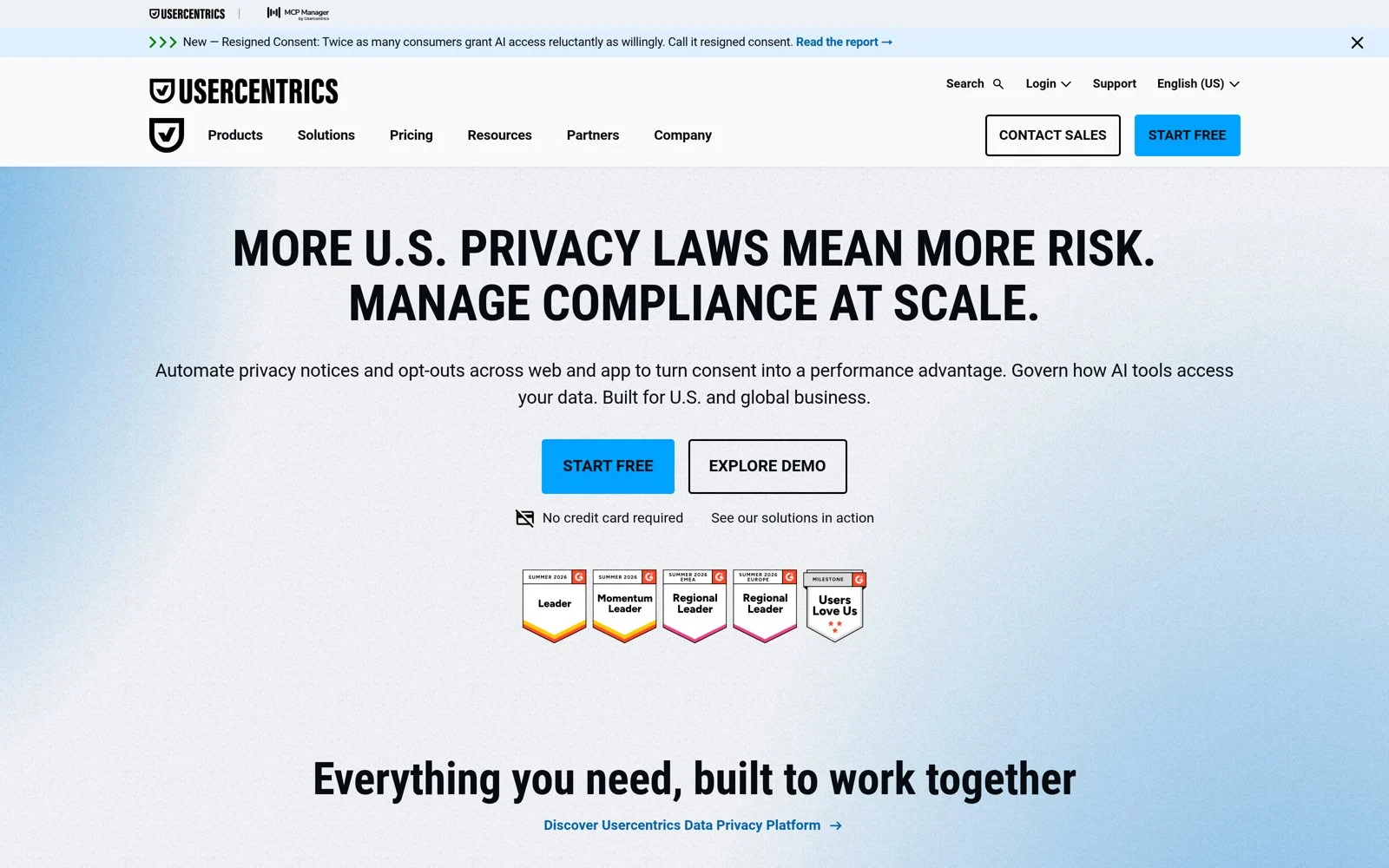
Best for: Privacy and MarTech leaders who need one certified CMP to cover websites, mobile apps, and CTV while keeping Google Ads and Analytics measurement intact under Consent Mode v2.
- Usercentrics reports 2.4M websites and apps across 195 countries and 8.8 billion consents collected every month
- Google lists UserCentrics CMP (TCF CMP ID 5) as certified for web, app and CTV, and Usercentrics reports Gold tier status for 2026
- Public, session-based pricing starts free and scales to cross-domain consent sharing, Consent or Pay and A/B testing
- Rated 4.3/5 on G2 across roughly 208 reviews (search snippet), with a server-side tracking product alongside the CMP
Limitation: Public reviews and third-party roundups repeatedly cite slow support responses, billing and auto-renewal disputes, and session-capped plans that push growing sites onto pricier tiers, and Usercentrics’ own US page still lists IAB GPP support for the Web CMP as coming soon (App CMP only), which matters for teams managing US state opt-outs on websites.
Didomi

Best for: Privacy and MarTech leaders at multi-brand publishers and consumer brands that need one consent and preference stack across web, apps, and CTV in Europe and the US.
- Rated 4.5/5 on G2 across 177 reviews, with reviewers repeatedly citing responsive support and a reliable platform
- Google lists Didomi CMP (TCF CMP ID 7) as certified for web, app and CTV, backed by SDKs for iOS, tvOS, Android TV and Flutter
- A single notice can carry up to 21 regulations, including GDPR, CPRA, CPA and CTDPA, with GPP mapping and GPC honored
- Native notice A/B testing reports consent-rate lift, and Didomi cites a 12 percent consent-rate gain for Europcar
Limitation: G2 reviewers note that reporting is less intuitive than in rival tools and that the script’s web performance could be better, and advanced AMP, regional, or CTV setups can require developer help along with unclear app integration documentation.
Sourcepoint
Best for: Privacy and ad operations leaders at large digital publishers and media groups who need TCF and US state consent across web, app, and CTV properties without hurting ad revenue.
- Rated 4.7/5 across 54 reviews on G2 (search snippet), with a quality-of-support sub-score of 9.9
- Over 200 global enterprise customers per Marlin Equity Partners, which merged Sourcepoint into Didomi in July 2025
- Google lists Sourcepoint’s CMP (TCF CMP ID 6) as certified for web, app and CTV, with Consent Mode v2 supported
- A scenario builder with A/B testing and geotargeting supports Consent or Pay journeys for large news publishers
Limitation: Pricing is not published, a G2 reviewer notes the interface can be clunky with a learning curve, and the July 2025 merger into Didomi leaves some uncertainty about the long-term product roadmap and possible platform consolidation.
Ketch

Best for: Privacy and marketing ops leaders at growth and enterprise brands who need consent choices enforced downstream in their martech and data systems, not just captured in a banner.
- Rated 4.6/5 on G2 (search snippet), with reviewers frequently praising its onboarding team and ease of setup
- Ketch says it serves 3,500+ brands and processes 67.2 billion consent transactions every month
- Real-time server-to-server signals push consent decisions into downstream martech, data and AI systems
- Google lists Ketch (TCF CMP ID 340) as certified for web, app and CTV, and pricing is public with a no-expiry free tier
Limitation: G2 reviewers report a steep learning curve when customizing the platform, and because DSR automation, data mapping and preference management are priced separately from the CMP, buyers who want the full permissioning vision should expect a larger custom-priced Pro contract and more configuration effort across modules.
TrustArc

Best for: Enterprise privacy and legal teams that want cookie consent, preference management, DSARs and privacy program governance from one long-established vendor rather than a standalone banner tool.
- Main Capital’s October 2025 acquisition release cites 1,200+ enterprise customers in more than 25 countries
- Unlimited scans reach behind logins and forms, auto-categorize cookies, send change alerts and support auto-blocking
- Explicit US coverage: GPC, IAB GPP and named support for CCPA plus Virginia, Colorado, Texas, Oregon and other state laws
- 300+ no-code connectors push preferences into Salesforce, Marketo, HubSpot and Adobe; G2 4.2/5 across 328 reviews (snippet)
Limitation: G2 reviewers most often cite a difficult, time-consuming setup and learning curve plus occasional slowness, and G2’s own summary notes the enterprise focus may not suit smaller businesses, while TrustArc’s public materials do not document CTV SDKs, server-side consent or banner A/B testing for consent-rate optimization.
iubenda

Best for: Small and mid-sized businesses, ecommerce teams and agencies that want affordable, quick-to-deploy consent banners bundled with auto-updating privacy policies across many client sites.
- iubenda says more than 150,000 brands use its consent solution, and Trustpilot rates it 4.4/5 across 622 reviews
- Google lists the iubenda CMP (TCF CMP ID 123) as certified for web and app, with Consent Mode v2 built in
- Geolocated banners cover GDPR, UK GDPR, US state laws, LGPD and nFADP, with IAB GPP supported since December 2022
- One per-site subscription bundles the banner, auto-updating privacy and cookie policies, terms and consent records
Limitation: Several Capterra reviewers say support can be slow or inconsistent and that vendors missing from iubenda’s service database are hard to add, its strongest controls (hourly scans, the mobile SDK, detailed analytics and consent recovery) are reserved for the $99.99 per site Ultimate tier, and its public materials say little about enterprise multi-brand governance or server-side tagging.
Osano

Best for: Privacy and marketing leaders at growing US companies who want compliant cookie consent live in days plus DSAR, vendor risk, and assessments under one vendor.
- Osano cites a 4.5/5 G2 rating from 175+ reviews, and reviewers consistently praise ease of setup and responsive support
- Banners cover privacy laws in 50+ countries and 40+ languages, deployed with a single line of JavaScript
- Consent audit logs capture banner version, device and timestamp, backed by a No Fines, No Penalties guarantee
- Native iOS, Android and React Native SDKs extend consent to apps, with Consent Mode v2 supported on iOS
Limitation: G2 review summaries cite limited banner customization and higher cost than alternatives, there is no self-serve tier between the $0 Free plan and the $199/mo Plus plan, and Osano does not publicly document IAB GPP string support or CTV SDKs, which matters for ad-heavy publishers.
CookieYes
Best for: Small and mid-sized businesses, WordPress and Shopify site owners, and agencies that need fast, low-cost cookie compliance with Google Consent Mode v2 across many sites.
- Rated 4.8/5 across 302 G2 reviews (search snippet), and its WordPress plugin has more than 1 million active installs
- Google lists CookieYes (TCF CMP ID 401) as a certified CMP for web and app, covering Google ad serving in the EEA and UK
- Public pricing starts free, with paid tiers from $10 to $55 per domain per month, and Consent Mode v2 on every plan
- An agency dashboard manages client portfolios, replicates settings across sites and supports white-label delivery
Limitation: CookieYes is built for websites rather than complex enterprise estates: its own materials do not document IAB GPP string support, server-side or CTV consent, banner A/B testing or consent-rate analytics, and its only SDK found is an open-source React/Next.js web package rather than native iOS or Android SDKs, while at least one Capterra reviewer reported the banner slowed mobile sites and the 800+ entry TCF vendor list was hard to manage.
Termly

Best for: Small and midsize businesses, and the agencies that serve them, who want an inexpensive, quick-to-install cookie banner bundled with auto-updated legal policies.
- Termly says over 2 million businesses use it, and Trustpilot rates it 4.3/5 across 599 reviews
- Google lists Termly CMP (TCF CMP ID 412) as certified for web, and Termly reports Gold Consent Mode partner status
- Public pricing starts free, and the $15 per site Pro+ tier unlocks Consent Mode v2, IAB TCF 2.3 and regional rules
- Cookie scanning, an Auto Blocker, auto-generated cookie policies, consent logs and DSAR forms share one dashboard
Limitation: Termly is built for SMB web properties rather than enterprise programs: Google lists its certified CMP for Web only with no documented mobile app or CTV SDK, IAB GPP support is not documented, and rfp.wiki’s review summary notes that some teams want deeper enterprise controls and integrations, with mixed support experiences.
Side-by-Side Comparison
Summary of where each Consent Management Platforms tends to fit best.
| Platform | Best For | Key Strength | Primary Limitation | Score |
|---|---|---|---|---|
| OneTrust | Large enterprises unifying consent with DSAR, vendor risk and AI governance | Deep scanning, 250+ languages, TCF ID 28 across web, app and CTV | Reviewers and aggregators consistently cite meaningful setup effort across modules and geographies plus opaque, quote-only pricing, and the wind-down of the lower-cost Pro tier has drawn complaints about sharp renewal increases, so smaller teams may find it heavier and costlier than a focused CMP. | 94 |
| Usercentrics | Brands needing one certified CMP across web, app, and CTV | Google Gold Tier CMP with Consent Mode v2 and 8.8B monthly consents | Public reviews and third-party roundups repeatedly cite slow support responses, billing and auto-renewal disputes, and session-capped plans that push growing sites onto pricier tiers, and Usercentrics’ own US page still lists IAB GPP support for the Web CMP as coming soon (App CMP only), which matters for teams managing US state opt-outs on websites. | 91 |
| Didomi | Brands and publishers unifying consent across web, apps, and CTV | Google Gold CMP partner with 21-regulation notices and broad SDKs | G2 reviewers note that reporting is less intuitive than in rival tools and that the script’s web performance could be better, and advanced AMP, regional, or CTV setups can require developer help along with unclear app integration documentation. | 90 |
| Sourcepoint | Large publishers running TCF and US state consent across web, app and CTV | Publisher-grade consent optimization with A/B testing and top-rated support | Pricing is not published, a G2 reviewer notes the interface can be clunky with a learning curve, and the July 2025 merger into Didomi leaves some uncertainty about the long-term product roadmap and possible platform consolidation. | 88 |
| Ketch | Brands enforcing consent across martech and data pipelines | Server-side consent signals plus TCF, GPP and Google certification | G2 reviewers report a steep learning curve when customizing the platform, and because DSR automation, data mapping and preference management are priced separately from the CMP, buyers who want the full permissioning vision should expect a larger custom-priced Pro contract and more configuration effort across modules. | 87 |
| TrustArc | Enterprises wanting consent bundled with DSAR, assessments and privacy governance | Google-certified CMP (ID 47) with deep US state-law and GPP coverage | G2 reviewers most often cite a difficult, time-consuming setup and learning curve plus occasional slowness, and G2’s own summary notes the enterprise focus may not suit smaller businesses, while TrustArc’s public materials do not document CTV SDKs, server-side consent or banner A/B testing for consent-rate optimization. | 86 |
| iubenda | SMBs and agencies wanting cheap per-site consent plus auto-updating legal docs | Google Gold CMP, TCF ID 123, and a bundled policy generator | Several Capterra reviewers say support can be slow or inconsistent and that vendors missing from iubenda’s service database are hard to add, its strongest controls (hourly scans, the mobile SDK, detailed analytics and consent recovery) are reserved for the $99.99 per site Ultimate tier, and its public materials say little about enterprise multi-brand governance or server-side tagging. | 82 |
| Osano | Growing US companies wanting fast consent plus DSAR and vendor risk in one suite | Easy setup, Google certified TCF CMP (ID 279), no-fines guarantee | G2 review summaries cite limited banner customization and higher cost than alternatives, there is no self-serve tier between the $0 Free plan and the $199/mo Plus plan, and Osano does not publicly document IAB GPP string support or CTV SDKs, which matters for ad-heavy publishers. | 81 |
| CookieYes | SMBs, WordPress/Shopify sites and agencies needing low-cost certified consent | Google-certified CMP with Consent Mode v2 on a free plan, paid from $10/mo | CookieYes is built for websites rather than complex enterprise estates: its own materials do not document IAB GPP string support, server-side or CTV consent, banner A/B testing or consent-rate analytics, and its only SDK found is an open-source React/Next.js web package rather than native iOS or Android SDKs, while at least one Capterra reviewer reported the banner slowed mobile sites and the 800+ entry TCF vendor list was hard to manage. | 79 |
| Termly | SMBs and agencies wanting a cheap banner bundled with legal policies | Google-certified TCF CMP (ID 412) with public pricing from $0 | Termly is built for SMB web properties rather than enterprise programs: Google lists its certified CMP for Web only with no documented mobile app or CTV SDK, IAB GPP support is not documented, and rfp.wiki’s review summary notes that some teams want deeper enterprise controls and integrations, with mixed support experiences. | 75 |
How Mktg.Tech Evaluated Each Consent Management Platform
We used our 7-Point Evaluation Framework™, weighted for what matters most to Privacy & MarTech Leaders.
Scope & Breadth
Consent Coverage Breadth – how many channels and legal frameworks one deployment covers, from web, app and CTV to IAB TCF, GPP, Google Consent Mode v2 and the growing list of US state privacy laws.
Quality & Reliability
Scanning & Enforcement Accuracy – whether the platform finds every cookie, pixel and tracker on a property and actually blocks it until consent, rather than displaying a banner that changes nothing underneath.
Utility & Output
Consent Rate Optimization – the tooling for lawfully improving opt-in rates, including banner A/B testing, consent analytics and the reporting that shows how much addressable data a configuration recovers or loses.
Communication & Integration
Martech Signal Propagation – how reliably a consent decision reaches the tag manager, ad platforms, analytics, CDP and CRM, including server-side delivery, rather than stopping at the browser.
Operational Excellence
Multi-Property Governance – how well one team can run consent across many domains, apps, brands and regions, with geolocation rules, templates, roles and change control instead of per-site configuration.
Trust & Versatility
Certification & Regulatory Credibility – published security certifications, Google certified CMP status, IAB TCF registration and data residency, judged on what can be verified against a primary source.
Evidence & Impact
Verified Outcomes & Recognition – named customers with quantified consent, revenue or efficiency results, plus independent analyst and review-platform validation of the consent product specifically.
How We Scored Each Consent Management Platform
Data Sources Used
- Official Platform & Pricing Pages: Published plans, domain and session limits, and feature gating read from each vendor’s own live pages, with quote-only pricing recorded as such rather than estimated.
- Google Certified CMP List: Every entrant’s certification status, IAB TCF CMP ID and supported platforms (web, app, CTV) checked against Google’s own certified CMP list rather than vendor badges.
- Developer & Implementation Documentation: Consent Mode v2, TCF, GPP, SDK and server-side support confirmed in technical documentation, not inferred from marketing copy.
- Independent Review Platforms: Ratings, counts and recurring themes from G2, Capterra, TrustRadius and Trustpilot, with every blocked listing and search-snippet-only figure disclosed.
- Security & Compliance Disclosures: Trust centers and certification pages read directly for SOC 2, ISO 27001, ISO 27701 and data residency, with absent certifications recorded as absent.
- Operational Case Studies: Named customer stories with quantified consent, revenue or efficiency outcomes, every one labeled vendor-published rather than independently audited.
- Ownership & Corporate Disclosures: Acquisition announcements and investor releases used to establish who owns each platform today, since several changed hands inside the last eighteen months.
Evaluation Filters
- Core Consent Capability: Must collect, store and enforce user consent as a primary product, not as a side feature of a website builder, tag manager or analytics suite.
- Google Certified CMP: Must appear on Google’s certified CMP list in 2026, the practical entry requirement for serving Google ads to users in the EEA, UK and Switzerland.
- Active Development: Must show material product activity during 2025 or 2026, such as TCF 2.2 or later, GPP or Consent Mode v2 support, evidenced by dated documentation or announcements.
- Marketing and Privacy Operable: Must be configurable by the customer’s own privacy or marketing team. Fully managed legal services and pure policy generators were excluded.
- Verifiable Public Evidence: Must publish enough about pricing, certification or customer outcomes to be independently checked. Vendors offering no auditable evidence were not scored.
What’s Inside the Download
How the Framework Is Weighted
| Criteria | Weight | Relative Emphasis |
|---|---|---|
| Scope & Breadth | 20% | |
| Quality & Reliability | 15% | |
| Utility & Output | 15% | |
| Communication & Integration | 15% | |
| Operational Excellence | 15% | |
| Trust & Versatility | 10% | |
| Evidence & Impact | 10% |
Tool Background & Engagement Profile
| Platform | HQ / Parent Company | Typical Client Size | Primary Focus |
|---|---|---|---|
| OneTrust | Atlanta, Georgia, USA (independent, privately held) | Mid-market to enterprise | Enterprise consent inside a full privacy governance suite |
| Usercentrics | Munich, Germany (independent company; merged with Cookiebot parent Cybot of Copenhagen, Denmark in 2021, backed by Full In Partners) | SMB to enterprise | Web, app, and CTV consent with Google signal integration |
| Didomi | Paris, France (majority-owned by Marlin Equity Partners; merged with New York-based Sourcepoint in 2025) | Mid-market to enterprise | Consent, preferences, and signal recovery across channels |
| Sourcepoint | New York, NY, USA (part of Didomi, Paris, France, a Marlin Equity Partners portfolio company, since July 2025) | Mid-market to enterprise | Publisher consent and monetization across web, app and CTV |
| Ketch | San Francisco, California, USA (independent, venture-backed) | SMB (free tier) to enterprise | Consent enforcement across the martech and data stack |
| TrustArc | Walnut Creek, California, USA (owned by Main Capital Partners, The Hague, Netherlands, since October 2025) | Mid-market to enterprise | Consent inside an end-to-end enterprise privacy suite |
| iubenda | Milan, Italy (part of team.blue since 2022) | SMB to mid-market, plus agencies | Self-serve cookie consent and legal docs for SMB sites |
| Osano | Austin, Texas, USA (Osano, Inc., a Public Benefit Corporation, independent) | SMB to mid-market, some enterprise | All-in-one privacy platform with fast cookie consent |
| CookieYes | Milton Keynes, United Kingdom (CookieYes Limited, part of Mozilor; offices also listed in London and Kochi, India) | SMB to mid-market, plus agencies | Affordable self-serve website cookie consent |
| Termly | Seattle, Washington per G2 and Built In listings (snippet-only; CB Insights lists Spokane, WA); owned by group.one, headquartered in Sweden | Small business to mid-market, plus agencies | Low-cost consent banners plus legal policy generators |
Key Capabilities Offered
OneTrust
- Scheduled and authenticated cookie and tracker scanning
- Auto-blocking via no-code, tag manager or script rewriting
- Geolocated banners in 250+ languages with A/B testing
- IAB TCF, IAB GPP and Google Consent Mode v2 signaling
- Mobile app and OTT/CTV consent SDKs
- Cross-device consent sync and consent transaction records
Usercentrics
- Web, App (SDK), and CTV consent management
- Google Consent Mode v2 and Google tag integration
- IAB TCF support (CMP ID 5)
- Automatic Global Privacy Control (GPC) detection
- Server-side tracking and cross-domain consent sharing
- Consent analytics and A/B testing (Corporate)
Didomi
- IAB TCF and GPP consent notices with Google Consent Mode v2
- Web, mobile, and CTV SDKs (iOS, tvOS, Android TV, Flutter, Unity)
- Consent notice A/B testing and analytics dashboards
- Preference management synced to CRM, CDP, and email tools
- Advanced Compliance Monitoring tracker scans and audit reports
- Server-side tagging via Addingwell with consent checks
Sourcepoint
- IAB TCF 2.2 and GPP-based US multi-state consent messaging
- Unified SDK for in-app and CTV/OTT consent
- Scenario builder with A/B testing and geotargeting
- Google Consent Mode v2 integration
- Vendor scanning and compliance monitoring (Diagnose)
- DSAR workflows and Universal Consent & Preferences center
Ketch
- Consent banners with privacy law templates
- IAB TCF 2.2 and IAB GPP signal support
- Google Consent Mode support
- Server-to-server consent propagation
- Native iOS, Android and React SDKs
- Continuous tracker and tag scanning
TrustArc
- Geo-specific cookie banners from one script for web and mobile apps
- Unlimited tracker scanning, auto-categorization and auto-blocking
- Google Consent Mode support as a certified CMP (TCF ID 47)
- IAB TCF 2.2, IAB CCPA and IAB GPP plus GPC signal handling
- Mobile SDKs with Firebase, AppsFlyer, AirBridge and Singular
- 300+ no-code connectors to sync preferences to martech systems
iubenda
- Automated cookie and tracker scanning (monthly to hourly by plan)
- Prior blocking of scripts until consent
- Geo-targeted banners for GDPR, US state laws, LGPD and nFADP
- IAB TCF 2.2, Google Consent Mode v2 and IAB GPP signals
- Mobile SDK for native in-app consent (Ultimate plan)
- Consent records plus privacy policy and terms generators
Osano
- AI-assisted cookie and pixel discovery and classification
- Script and tag blocking until consent
- Geo-targeted banners in 40+ languages
- IAB TCF 2.2 and Google Consent Mode v2
- Consent audit logs with banner version and timestamp
- iOS, Android, and React Native consent SDKs
CookieYes
- Automated cookie scanning with scheduled monthly or weekly scans
- Auto-blocking of non-essential scripts before consent
- Geo-targeted banners for GDPR, CCPA/CPRA, LGPD and US state laws
- Google Consent Mode v2 plus IAB TCF and Global Privacy Control
- Exportable consent log for audit proof
- Agency dashboard with bulk site management and white-label
Termly
- Site cookie scanning with six-category classification
- Auto Blocker for third-party cookies and scripts
- Google Consent Mode v2 and IAB TCF 2.3 (Pro+)
- Region-based banner rules and Global Privacy Control opt-out
- Auto-generated cookie, privacy, and terms policies
- Consent logs, DSAR forms, and multi-site agency management
Final Takeaway From Mktg.Tech
Across all evaluated sources and weighted performance criteria, OneTrust ranks as the strongest overall consent management platform for 2026. It wins on the criterion that carries the most weight, consent coverage breadth, because one certified deployment (TCF CMP ID 28) covers web, app and CTV with TCF, GPP and Consent Mode v2 documented, and it pairs that with the deepest scanning in this report, backed by a 45 million cookie classification database, and with governance across 250+ languages and many regions. For teams whose consent program sits beside DSAR handling, vendor risk and data mapping, no other entrant ties them together as completely. Usercentrics runs it closest and is the better fit for a team that wants a focused, Google-aligned CMP across web, app and CTV with public pricing to start, while Didomi leads on consent-rate optimization and SDK breadth for consumer brands that live on first-party data.
The more important finding is structural. Didomi and Sourcepoint, ranked third and fourth, have shared an owner since July 2025, Usercentrics also sells Cookiebot, and TrustArc changed hands in October 2025, so a shortlist that treats these as fully independent vendors is already out of date. Below the enterprise tier, iubenda, Osano, CookieYes and Termly remain genuinely good choices for smaller teams and agency portfolios, with public pricing and fast setup, but most of them stop at the website and leave app, CTV and server-side consent undocumented. The single most important decision factor is narrower than the feature lists suggest: decide whether consent has to stop at the browser or travel into your ad platforms and customer data platforms, because the platforms that propagate it downstream are rarely the cheapest ones to deploy.
Editorial Independence & About Mktg.Tech
About This Research
This report was independently produced by the Mktg.Tech Research & Insights team. Rankings are based on publicly available information, Google’s certified CMP list, vendor developer and security documentation, independent review-platform data, ownership disclosures, and structured evaluation against our 7-Point Evaluation Framework. No vendor included in this analysis paid for placement, ranking influence, or editorial consideration. Rankings will be reviewed and updated on a quarterly basis as consent management platforms, US state privacy law and the consolidation of this category continue to evolve.

Share Your 2026 Recognition
The companies featured in Mktg.Tech’s Best Consent Management Platforms of 2026 are invited to display this official badge on their website, documentation, or marketing materials. For transparency and verification, the badge should link back to the official report.
Use of this badge is intended for platforms included in the 2026 report and signifies verified inclusion.
Frequently Asked Questions
What are the best consent management platforms in 2026?
OneTrust ranks #1 in our 2026 evaluation with a score of 94 out of 100. It is best for privacy and MarTech leaders at large, multi-region organizations who want cookie, app and CTV consent governed in the same platform as DSARs, vendor risk and AI governance.
How many consent management platforms did Mktg.Tech evaluate?
We evaluated and scored 10 consent management platforms for this ranking. Each one was assessed against the same 7-Point Evaluation Framework and scored out of 100, then ordered by final score.
How does Mktg.Tech score consent management platforms?
Every entrant is measured against seven weighted categories: Scope & Breadth (20%), Quality & Reliability (15%), Utility & Output (15%), Communication & Integration (15%), Operational Excellence (15%), Trust & Versatility (10%), and Evidence & Impact (10%). The weights total 100%, and the resulting score determines each platform’s rank.
Which consent management platform is the best alternative to OneTrust?
Usercentrics ranks #2 with a score of 91 out of 100 and leads the Multi-Channel CMP category, making it the strongest alternative for teams whose priorities differ from the overall winner.
Are these rankings sponsored or paid placements?
No. No vendor paid for placement, ranking influence, or editorial consideration. Rankings are based on publicly available information and structured evaluation, and are reviewed and refreshed on a quarterly basis.
How to Choose the Right Consent Management Platforms
Choosing a consent management platform in 2026 is less about the banner than about what happens after the click. Every platform in this report can display a compliant notice. They differ enormously in whether that decision actually blocks the trackers it is supposed to block, reaches the ad platforms and data systems downstream, and survives the move from one website to a portfolio of sites, apps and streaming properties. Teams that buy on banner design almost always discover the gap later, usually during an audit or a drop in measured conversions.
The second thing to settle before a demo is who owns consent inside your company. Where privacy, legal and marketing share it, an enterprise suite that ties consent to data mapping, DSAR handling and vendor risk earns its cost. Where marketing owns it alone and runs a handful of sites, a lighter platform with public pricing and a fast setup is usually the better buy. Buying the suite without the program to use it is the most expensive mistake in this category, and buying the lightweight tool when you need governed, multi-region, multi-channel consent is the second.
1. Map Every Channel and Law You Must Cover
Coverage is the first filter because the gaps are binary: a platform either supports your app, CTV or US state-law obligations or it does not. Inventory what you actually run before you look at a feature grid.
- Channel Inventory: List every website, mobile app, AMP page and connected TV app that collects data, then confirm each one is certified on Google’s CMP list for that platform.
- Framework Support: Confirm IAB TCF 2.2 or later for European ad inventory and IAB GPP for US state opt-outs, since several platforms still support one but not the other.
- US State Laws: Check how the platform handles Global Privacy Control and opt-out rights across the US states where you have users, not only California.
- Language and Region Rules: Verify geolocation rules can switch the notice by country and state, and that every language you serve is supported without custom code.
2. Test Enforcement, Not the Banner
A banner that records a refusal while tags keep firing is worse than no banner, because it documents the violation. Test what actually loads before consent on your own properties.
- Scan Depth: Ask how often scans run on your tier, whether they reach pages behind logins and forms, and how large the cookie classification database is.
- Auto-Blocking: Confirm scripts are held until consent through tag manager rules or script rewriting, and test it yourself in a clean browser before signing.
- Change Alerts: Require alerts when a new tracker appears, since marketing teams add tags continuously and yesterday’s compliant site drifts quietly.
- Audit Evidence: Check that consent records can be exported with timestamps and notice versions, which is what a regulator or auditor will ask to see.
3. Measure the Data You Keep
Consent rate is now a marketing metric. Every point of opt-in lost is measurement, remarketing and personalization the business cannot use, so the platform should report it and help you improve it lawfully.
- A/B Testing: Look for native testing of banner layouts and copy, and check which pricing tier unlocks it, since it is often reserved for the top plan.
- Consent Analytics: Require reporting on opt-in, opt-out and dismissal rates by region, device and property, not just a total consent count.
- Consent Mode Modeling: Confirm Google Consent Mode v2 is implemented in advanced mode where appropriate, so modeled conversions can partly recover unconsented traffic.
- Lawful Design: Make sure optimization stays inside regulator guidance, with an equally prominent reject option, since dark patterns are an enforcement priority.
4. Follow the Signal Downstream
Consent captured in the browser is only half the job. The decision has to reach every system that stores or activates personal data, or those systems keep processing data the user refused.
- Tag Manager Integration: Check for a maintained Google Tag Manager template and support for other tag managers you run, including server-side containers.
- Server-to-Server Delivery: Ask whether consent can be pushed through APIs or webhooks into the CDP, CRM and warehouse, not only read from a browser cookie.
- Authenticated Consent: Confirm consent can be linked to a logged-in user and synced across devices, so a choice made on mobile applies on desktop.
- Ad Platform Signals: Verify signals reach Google, Microsoft, Amazon and the programmatic stack in the formats each one expects.
5. Price the Portfolio, Then Check the Owner
Consent pricing scales on domains, sessions or monthly visitors, so a cheap entry plan can become expensive across a real portfolio. Model the full estate for twelve months, then confirm who owns the vendor.
- Pricing Unit: Identify whether you pay per domain, per session or per visitor band, and model the next tier up, where costs often jump.
- Feature Gating: Note which plan unlocks TCF, A/B testing, multiple users and SSO, since these are frequently held back from entry tiers.
- Ownership: Check recent acquisitions and mergers, since several vendors here changed hands recently and product roadmaps can consolidate.
- Exit Terms: Agree consent-record export and data deletion terms before signature, since consent logs are evidence you must keep after switching.
Final Takeaway
The right consent management platform should protect the business from regulatory risk without silently shrinking the data marketing depends on. Prioritize platforms that offer:
- Complete Coverage: certified on Google’s CMP list for every channel you run, with TCF, GPP and Consent Mode v2 supported rather than on a roadmap.
- Enforcement You Can Test: with scans that reach every page and trackers blocked until consent, verified in your own browser before signature.
- Consent-Rate Visibility: with analytics and A/B testing that show how much addressable data each configuration keeps or loses.
- Signals That Travel: reaching tag managers, ad platforms, CDPs and CRMs, ideally server to server, not stopping at the browser cookie.
- A Vendor You Can Verify: with published certifications, transparent pricing or contract benchmarks, and an ownership structure you understand.
One pattern runs through this whole category and it is worth stating plainly: the vendors that publish a price, document their standards support and show a certified listing on Google’s own page are not automatically the better products, but they are the only ones you can evaluate before you sign. Across these ten platforms G2 blocked nearly every automated request, Google’s certified list confirms certification but shows no partner tiers, so every Gold tier claim in this category is the vendor’s own, and only a minority publish a quantified customer outcome. Make each vendor prove the specific claim your business case rests on, in writing, during the evaluation. And check who owns the product before you shortlist it: Didomi and Sourcepoint now share an owner, and Usercentrics also sells Cookiebot.