An Independent Review for Programmatic & Paid Media Teams
Programmatic buying in 2026 is being rebuilt around AI agents, clean rooms and streaming TV. Moving beyond manual line-item bidding on open-web display, the leading demand-side platforms now plan, bid and measure across connected TV, retail media, audio and digital out-of-home, with AI that turns a brief into a live campaign. This report provides a structured comparison of the leading demand-side platforms, with The Trade Desk leading the market, to help programmatic and paid media teams select the right DSP for their specific needs. It also records a market in motion: Microsoft shut down its Invest DSP in February 2026, Amazon folded its DSP into an AI agent at unBoxed 2026, and MediaMath now runs under Infillion after its 2023 bankruptcy. Search and social budgets, which most teams manage with PPC management software, sit outside this report.
The Trade Desk
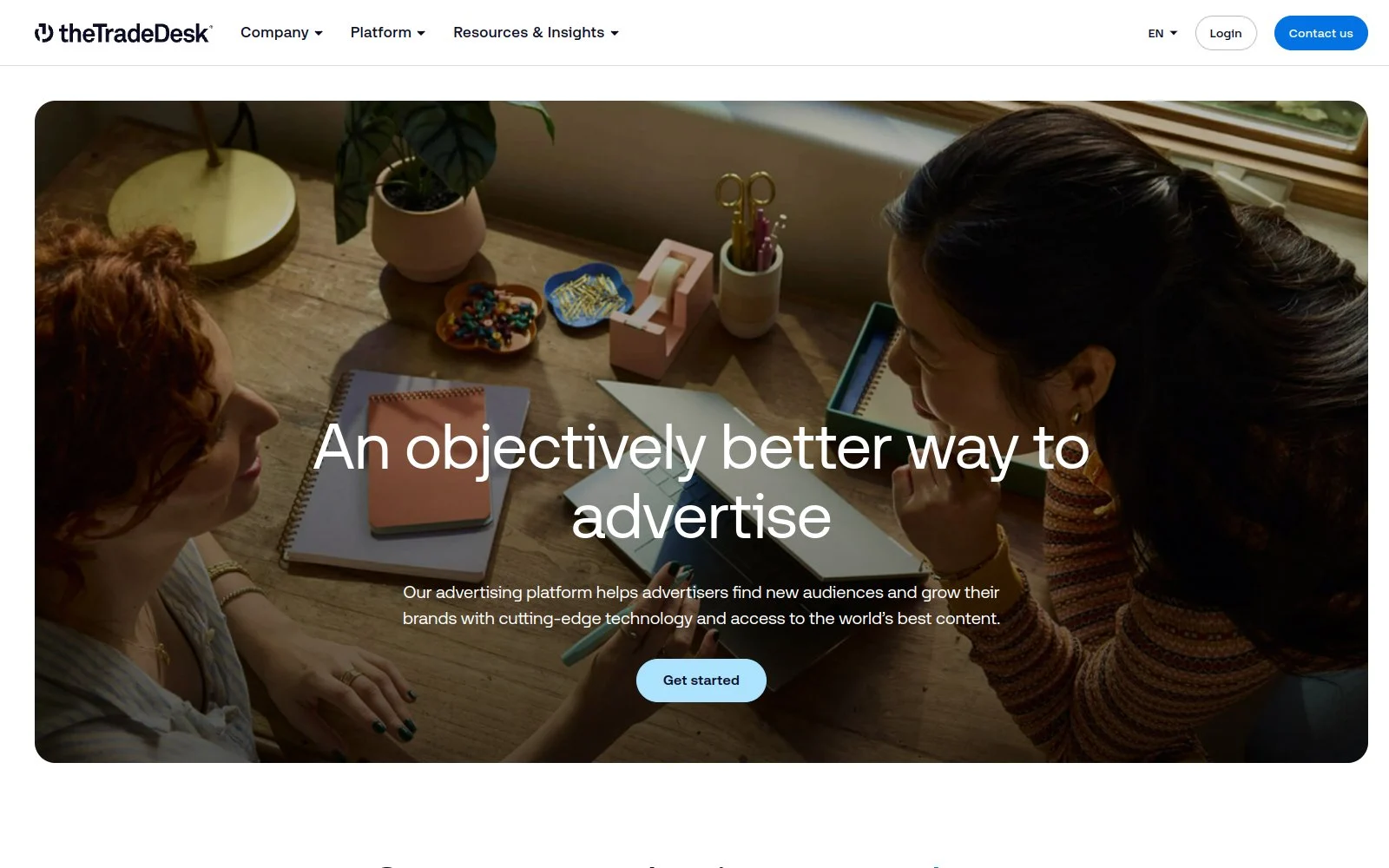
Best for: Agency trading desks and large brands that want an independent, omnichannel DSP with strong CTV reach and no walled-garden media conflicts.
- Rated 4.4/5 on G2 and 9.0/10 on TrustRadius, with targeting depth and responsive support most often praised.
- Customer retention stayed above 95% in Q2 2026, a level the company says it has held for over a decade.
- Kokai AI optimization plus the Aug 2026 Zuma release add Conversion Lift, Report Builder and agentic tools.
- OpenTTD unifies UID2, OpenPath, OpenAds and OpenPass APIs for cleaner supply paths and portable identity.
Limitation: Its take rate, which the company puts around 20%, is among the highest in the category, and the platform has a steep learning curve, with agency pushback over the forced Kokai migration and OpenPath exits by Dentsu and WPP.
Google Display & Video 360

Best for: Large advertisers and agency trading desks that want YouTube, CTV and open-web programmatic in one Google-integrated stack.
- Exclusive programmatic access to YouTube reserved and auction inventory, plus Ad Manager and many exchanges.
- Google says its proprietary audience segments in DV360 now reach 96% of US ad-supported CTV households.
- Rated 4.5/5 on Gartner Peer Insights across 37 ratings, with product capabilities scored 4.6 by buyers.
- Gemini models now power bidding, and the Ads Advisor assistant builds and reports via plain prompts.
Limitation: Pricing is opaque and contract-based, the interface has a steep learning curve, and buying inside Google’s own ecosystem raises neutrality concerns for some buyers.
Amazon DSP
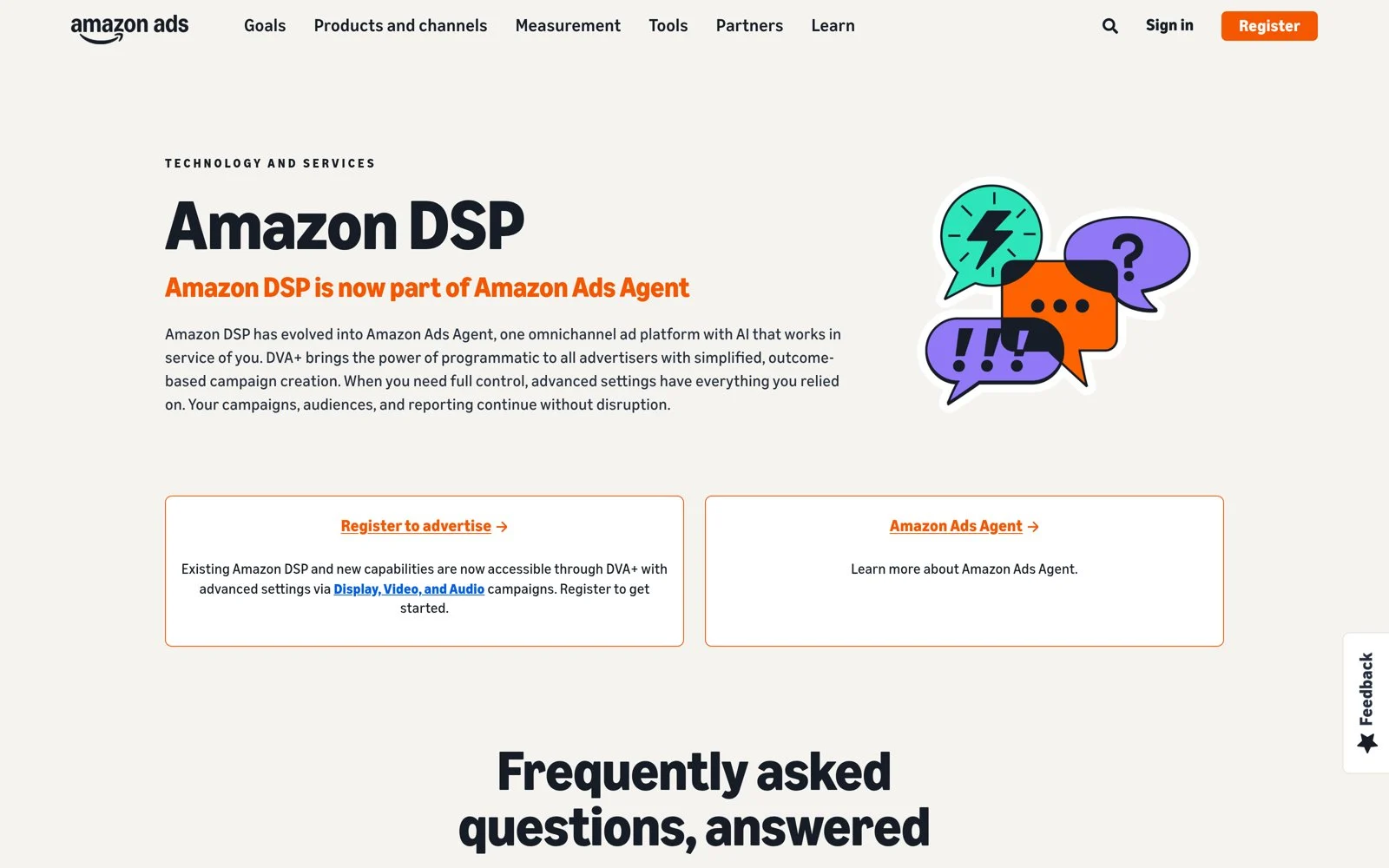
Best for: Brands and agencies, especially those selling on Amazon, that want CTV and open-web reach tied to closed-loop purchase data.
- Reaches an average 300M+ monthly US ad-supported audience across Prime Video, Fire TV, Twitch and partners
- Netflix, Roku and Disney streaming inventory buyable in one seat, with Roku pooling 80M US CTV households
- Amazon first-party shopping signals plus the Amazon Marketing Cloud clean room tie ad exposure to purchases
- Reported tech fees fell to roughly 1% to 8% in 2025, undercutting the take rates of legacy independent DSPs
Limitation: Its strongest data and measurement stay inside Amazon’s walled garden, and the 2026 shift to AI-led DVA+ defaults can reduce manual control unless buyers opt into advanced settings.
StackAdapt
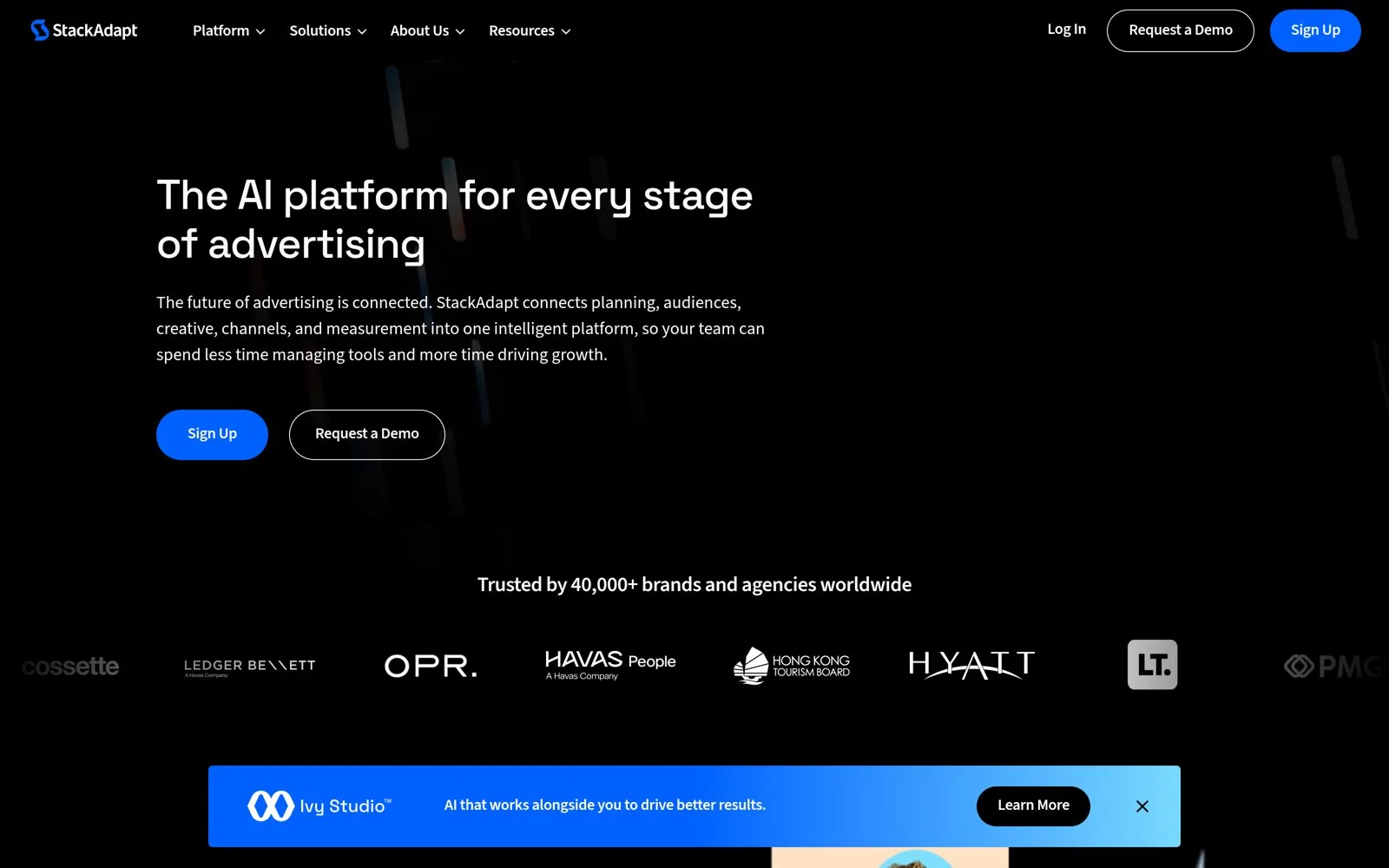
Best for: Mid-market brands and agencies that want one self-serve platform to run CTV, native, display, audio and newer channels with strong support and AI-assisted planning.
- Rated 4.7/5 on G2 across about 850 reviews, well above G2’s 4.25 average for the DSP category in 2026.
- Ten channels in one buy, including CTV, native, DOOH, in-game, email, direct mail and ChatGPT Ads placements.
- Ivy Studio AI workspace lets teams plan, forecast, analyze and optimize campaigns conversationally or via UI.
- Data Hub, API and MCP access connect CRM and first-party data, with LiveRamp onboarding for people targeting.
Limitation: Pricing and fees are not published and depend on negotiation, and enterprise buyers needing deep custom bidding or clean-room workflows may find holding-company DSPs like The Trade Desk more extensible.
Viant DSP (ViantAI)
Best for: US agencies and brands shifting budget into CTV that want household-level, cookieless targeting and a cleaner supply path without walled-garden lock-in.
- Q2 2026 revenue reached $104.3M, up 34% year over year, with CTV above 50% of all platform ad spend.
- Household ID resolves 1.8B+ IPs and identifiers into 125M US households for cookieless, people-based targeting.
- Direct Access removes resellers from the CTV supply path; over 80% of Q2 2026 CTV spend ran through it.
- ViantAI covers planning, bidding, measurement and decisioning, and Outcomes runs fully autonomous campaigns.
Limitation: Its identity graph and supply strategy are built around US households, so global teams needing broad international reach or walled-garden and social buying will need another platform alongside it.
Yahoo DSP

Best for: Agency and brand trading teams that want an independent, interoperable alternative to walled gardens with logged-in identity and direct publisher supply.
- Named a Strong Performer in The Forrester Wave: Omnichannel Advertising Platforms, Q1 2026.
- Yahoo ConnectID scales reach across roughly 232 million authenticated users, per Yahoo data from January 2026.
- Backstage offers a direct path to premium publishers, including CTV, with fewer intermediary hops than SSPs.
- Agent Network launched June 2026 with 23 partners, including LiveRamp, DoubleVerify, IAS and Snowflake.
Limitation: User sentiment trails leaders at 3.6/5 on G2 (about 180 reviews), with reviewers citing a complicated interface, and Apollo has reportedly explored selling the DSP.
Basis

Best for: Agencies and in-house teams that want programmatic, direct, search and social planning, buying and billing in one system.
- Rated 4.5/5 on G2 across 287 reviews (Sept 2026), and reviewers often praise how fast support responds.
- Plans, buys and bills programmatic, site direct, search and social in one platform, down to reconciliation.
- Its private marketplace library has more than 2,000 active deals across hundreds of premium publisher sites.
- Compass agentic AI, launched in 2026, turns campaign briefs into media plans that feed straight into activation.
Limitation: Reviewers on G2 say the interface can be complex and reporting is less real-time than expected, and pricing is quote-only with no public rate card.
Simpli.fi

Best for: Agencies, media groups and multi-location brands that need hyperlocal geo-fenced campaigns across CTV and display run at scale with hands-on support.
- Rated 4.5/5 on G2 from roughly 150 reviews, with reviewers scoring its quality of support at 9.3/10.
- Reports about 40,000 advertisers and more than 140,000 campaigns a month, focused on local media buyers.
- Geo-fencing, keyword search and CRM or intent audiences sit in one console alongside CTV, audio and DOOH.
- Simpli.Hub lets corporate teams package brand-approved campaigns that individual locations launch themselves.
Limitation: Pricing is opaque and quote-based, and G2 reviewers flag a complex dashboard, a learning curve and extra fees, so it is less suited to teams wanting transparent self-serve enterprise buying.
Infillion MediaMath
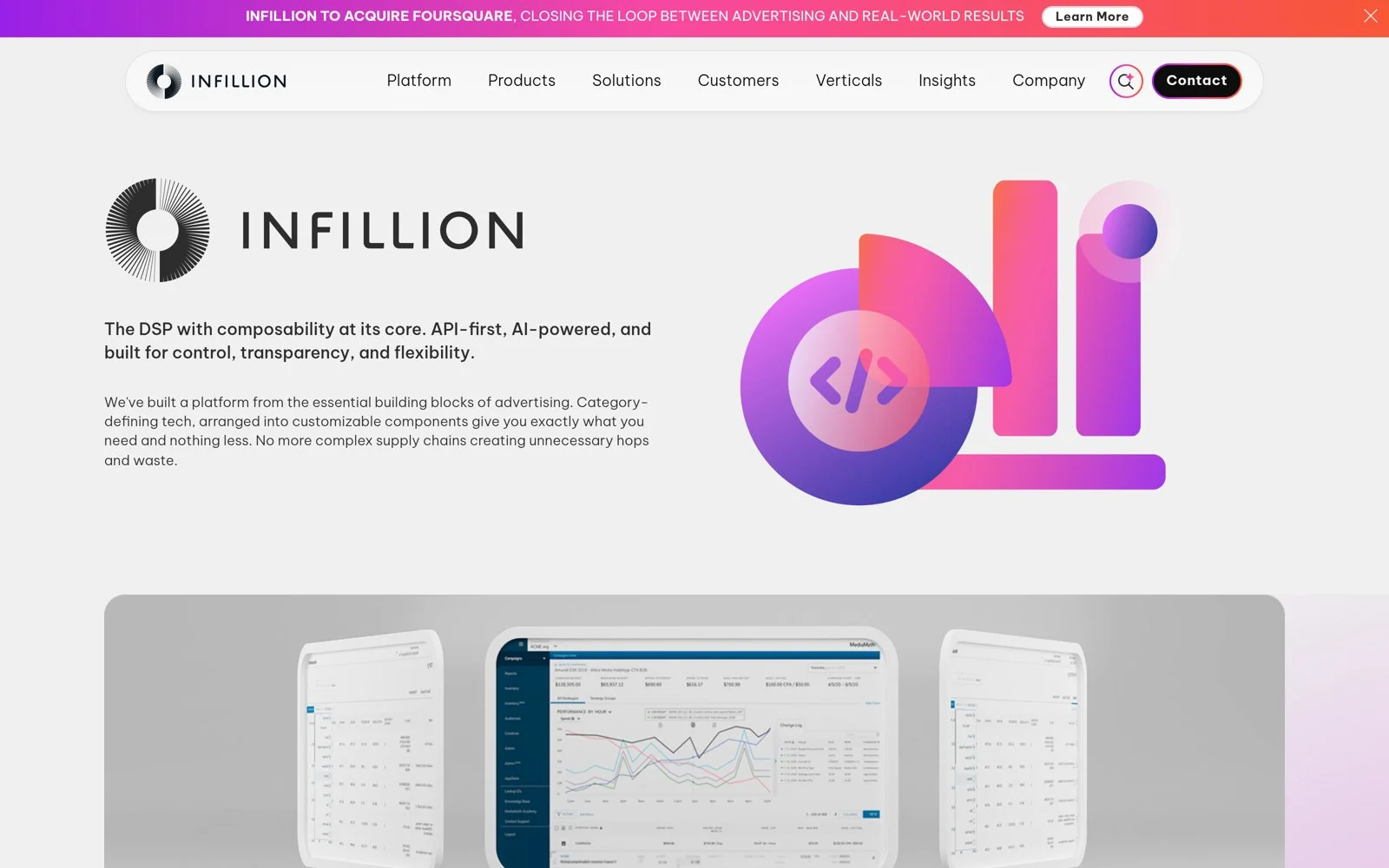
Best for: Agencies, brands and retail or commerce media networks that want an API-first DSP they can build on, with deterministic purchase data and closed-loop measurement attached.
- API-first, modular design lets brands and retail media networks build custom stacks on top of the DSP.
- Catalina deal adds deterministic purchase data on 130 million US households from loyalty programs.
- Agent Connector exposes planning, buying and reporting to MCP-compatible AI agents such as Claude.
- Built-in Arrival footfall and Uplift brand-lift measurement plus log-level reporting three times a day.
Limitation: G2 users rate it 3.9/5 across 126 reviews, below leaders like The Trade Desk (4.4/5), citing a dated interface and complex setup, and its post-bankruptcy scale and pricing are not publicly disclosed.
Madhive

Best for: Broadcast groups, local media sellers and agencies running market-level CTV and omnichannel campaigns for local and regional advertisers.
- Backed by a $300M Goldman Sachs Asset Management investment in 2023, valuing it near $1B (Axios).
- Runs the advanced TV businesses of broadcasters like FOX, Scripps and Gray Media, which covers 117 markets.
- Maverick AI Agents, launched May 2026, automate planning, activation and optimization for local campaigns.
- Fraud Free Guarantee since June 2025, plus measurement that ties CTV exposure to store visits and sales.
Limitation: Madhive is built around local and regional TV workflows, often white-labeled through broadcasters, so national brand teams looking for a self-serve, cross-channel global DSP will find it a narrow fit.
Side-by-Side Comparison
Summary of where each Demand-Side Platforms tends to fit best.
| Platform | Best For | Key Strength | Primary Limitation | Score |
|---|---|---|---|---|
| The Trade Desk | Agencies needing independent omnichannel CTV buying | Largest independent DSP with deep CTV supply and UID2 identity | Its take rate, which the company puts around 20%, is among the highest in the category, and the platform has a steep learning curve, with agency pushback over the forced Kokai migration and OpenPath exits by Dentsu and WPP. | 95 |
| Google Display & Video 360 | Enterprises buying YouTube plus open web | Only DSP with full programmatic YouTube access and Google data | Pricing is opaque and contract-based, the interface has a steep learning curve, and buying inside Google’s own ecosystem raises neutrality concerns for some buyers. | 93 |
| Amazon DSP | Amazon sellers and CTV buyers wanting purchase data | Closed-loop shopping data plus Prime Video, Netflix and Roku CTV | Its strongest data and measurement stay inside Amazon’s walled garden, and the 2026 shift to AI-led DVA+ defaults can reduce manual control unless buyers opt into advanced settings. | 92 |
| StackAdapt | Mid-market teams wanting one multichannel DSP | Broadest channel menu in a self-serve, highly rated UI | Pricing and fees are not published and depend on negotiation, and enterprise buyers needing deep custom bidding or clean-room workflows may find holding-company DSPs like The Trade Desk more extensible. | 88 |
| Viant DSP (ViantAI) | US CTV buyers wanting household-level targeting | Household ID plus direct CTV supply paths | Its identity graph and supply strategy are built around US households, so global teams needing broad international reach or walled-garden and social buying will need another platform alongside it. | 87 |
| Yahoo DSP | Identity-driven omnichannel buying outside walled gardens | Logged-in ConnectID identity plus direct Backstage publisher supply | User sentiment trails leaders at 3.6/5 on G2 (about 180 reviews), with reviewers citing a complicated interface, and Apollo has reportedly explored selling the DSP. | 85 |
| Basis | Agencies unifying programmatic, direct, search and social | Plans, buys and bills every channel in one workflow | Reviewers on G2 say the interface can be complex and reporting is less real-time than expected, and pricing is quote-only with no public rate card. | 84 |
| Simpli.fi | Local and multi-location campaigns | Hyperlocal geo-fencing and CTV at scale with strong support | Pricing is opaque and quote-based, and G2 reviewers flag a complex dashboard, a learning curve and extra fees, so it is less suited to teams wanting transparent self-serve enterprise buying. | 81 |
| Infillion MediaMath | API-first builders and retail media networks | Composable DSP with Catalina purchase data and MCP agent access | G2 users rate it 3.9/5 across 126 reviews, below leaders like The Trade Desk (4.4/5), citing a dated interface and complex setup, and its post-bankruptcy scale and pricing are not publicly disclosed. | 80 |
| Madhive | Broadcasters and local CTV advertisers | Local-market CTV workflow, white-labeled by major TV groups | Madhive is built around local and regional TV workflows, often white-labeled through broadcasters, so national brand teams looking for a self-serve, cross-channel global DSP will find it a narrow fit. | 79 |
How Mktg.Tech Evaluated Each Demand-Side Platform
We used our 7-Point Evaluation Framework™, weighted for what matters most to Programmatic & Paid Media Teams.
Scope & Breadth
Channel & Inventory Coverage – how many channels the DSP can buy from one seat, including CTV, online video, display, audio, digital out-of-home and retail media, and whether it reaches premium supply such as streaming apps, publisher direct deals and walled-garden inventory.
Quality & Reliability
Identity & Targeting Precision – the depth and durability of the audience data behind each bid, including first-party signals, deterministic or household identity graphs, and cookieless addressability that holds up as browsers and devices restrict tracking.
Utility & Output
Bidding Intelligence & Usability – how well the platform’s optimization and AI turn campaign goals into efficient spend, and whether traders can operate it day to day without a learning curve that slows every launch.
Communication & Integration
Data Partnerships & Clean Rooms – the strength of the DSP’s data marketplace, measurement partners, clean room connections and APIs, including whether advertisers can bring their own first-party data and AI agents into the buy.
Operational Excellence
Scale, Automation & Buying Models – the volume the platform proves it can run, how much of planning, pacing and reconciliation it automates, and whether it supports self-serve, managed and agentic buying models.
Trust & Versatility
Supply Transparency & Brand Safety – how clearly the DSP discloses fees and supply paths, the fraud and brand suitability controls it offers, its verification partners, and the privacy and security posture behind the data it activates.
Evidence & Impact
Verified Outcomes & Financial Proof – audited financials, retention and growth disclosures, analyst recognition and named case studies with quantified results, weighted toward independently verifiable evidence over vendor claims.
How We Scored Each Demand-Side Platform
Data Sources Used
- Official Platform & Product Pages: Channel lists, identity products, AI features and buying models read from each vendor’s own live product pages.
- Public Filings & Earnings Releases: Revenue, retention, CTV share and guidance taken from SEC filings and earnings releases for the publicly listed entrants and parents.
- Independent Review Platforms: Ratings, counts and recurring themes from G2, Capterra, TrustRadius, Trustpilot and Gartner Peer Insights, with blocked fetches and thin listings disclosed.
- Analyst & Award Verification: Analyst placements and industry awards checked against primary sources and tagged confirmed or unconfirmed.
- Trade Press Reporting: Fee, ownership and launch reporting from Digiday, Adweek, AdExchanger, Axios and others, labeled as third-party where vendors do not confirm it.
- Security & Supply Disclosures: SOC 2, ISO 27001, privacy, brand safety and supply path disclosures from vendor trust centers and partner announcements.
- Product Release Logs: Dated 2025 and 2026 launches, from Kokai and Zuma to Amazon Ads Agent, Compass and Maverick AI Agents, used to confirm active development.
Evaluation Filters
- Core DSP Capability: Must let advertisers or agencies buy programmatic media through real-time bidding or programmatic deals as a primary product, not as a minor feature of an ad network or a purely managed service.
- Multi-Channel Buying: Must buy across at least three channels from one platform, including connected TV or online video.
- Active Development: Must show dated product releases during 2025 or 2026, verified through announcements, release notes or public filings rather than a refreshed marketing page.
- Professional Focus: Must support agency or in-house trading teams with seats, permissions and reporting, through self-serve or managed access.
- Currently Sold: Must be commercially available in October 2026; platforms retired during the period, such as Microsoft Invest, are excluded.
What’s Inside the Download
How the Framework Is Weighted
| Criteria | Weight | Relative Emphasis |
|---|---|---|
| Scope & Breadth | 20% | |
| Quality & Reliability | 15% | |
| Utility & Output | 15% | |
| Communication & Integration | 15% | |
| Operational Excellence | 15% | |
| Trust & Versatility | 10% | |
| Evidence & Impact | 10% |
Tool Background & Engagement Profile
| Platform | HQ / Parent Company | Typical Client Size | Primary Focus |
|---|---|---|---|
| The Trade Desk | Ventura, CA, USA (public, Nasdaq: TTD) | Mid-market to enterprise agencies and brands | Independent omnichannel programmatic, CTV |
| Google Display & Video 360 | Mountain View, CA, USA (Google / Alphabet Inc.) | Enterprise brands and agencies; mid-market typically via resellers | Full-funnel omnichannel programmatic, YouTube |
| Amazon DSP | Seattle, WA, USA (Amazon.com, Inc.) | Mid-market to global enterprise brands and agencies; self-serve and managed service | Retail data-driven programmatic and CTV |
| StackAdapt | Toronto, ON, Canada (privately held; backed by Teachers’ Venture Growth and Summit Partners) | SMB to mid-market and enterprise brands and agencies (claims 40,000+ brands and agencies) | Self-serve multichannel programmatic with AI |
| Viant DSP (ViantAI) | Irvine, CA, USA (Viant Technology Inc., public on NASDAQ: DSP) | Mid-market to enterprise agencies and advertisers; self-serve and managed options | CTV, household identity, AI buying |
| Yahoo DSP | New York, NY, USA (Yahoo Inc., owned by Apollo Global Management) | Mid-market to enterprise brands and agencies | Omnichannel buying with first-party identity |
| Basis | Chicago, IL, USA (privately held, Basis Global Technologies, LLC) | Mid-market to enterprise agencies and brands | Omnichannel media workflow automation |
| Simpli.fi | Fort Worth, TX, USA (private; backed by GTCR and Blackstone) | SMB to mid-market; agencies, media groups, multi-location brands | Localized programmatic and CTV |
| Infillion MediaMath | New York, NY, USA (owned by Infillion) | Mid-market to enterprise; agency holding companies, independents, brands, retail and commerce media networks | Composable, data-rich omnichannel programmatic |
| Madhive | New York, NY, USA (private; Goldman Sachs Asset Management minority investor) | Mid-market to enterprise (broadcast groups, local media sellers, agencies) | Local CTV and omnichannel advertising |
Key Capabilities Offered
The Trade Desk
- Omnichannel buying across CTV, online video, audio, display, mobile and DOOH from one Kokai interface
- AI forecasting, bid optimization and agentic workflows (Koa, Zuma release) with Conversion Lift measurement
- Unified ID 2.0 (UID2) and OpenPass identity for cookieless, consented audience targeting
- OpenPath direct publisher supply paths plus Sincera inventory quality signals
- Deal Desk for managing PMP, programmatic guaranteed and forward-market (upfront-style) deals
- Retail data marketplace covering retailers representing over 80% of US retail sales, plus OpenTTD APIs
Google Display & Video 360
- Programmatic buying across display, video, CTV, audio and DOOH via Google Ad Manager and third-party exchanges
- YouTube buying including reserve, Shorts, Pause Ads, Creator Takeovers and biddable live sports on CTV
- Gemini-powered automated bidding plus Ads Advisor natural-language campaign setup and reporting
- Confidential Publisher Match identity in Trusted Execution Environments (e.g., Roku) for CTV-to-purchase measurement
- Retail data activation such as Kroger Precision Marketing audiences with SKU-level reporting
- Marketplace for curated deals, PMPs and programmatic guaranteed, plus brand-safety inventory modes and content themes
Amazon DSP
- Programmatic display, video, audio and streaming TV buying across Amazon O&O and third-party supply
- Premium CTV access including Prime Video, Thursday Night Football, Netflix, Roku and Fire TV
- Amazon Marketing Cloud clean room with an AI tool that turns natural-language requests into AMC SQL
- Amazon Ads Agent with Full-Funnel Campaigns and DVA+ for one-budget, AI-optimized cross-format buying
- Deals, supply-path controls, frequency caps and bid strategies via DVA+ advanced settings
- Generative AI creative tools that build display and video ads from existing product assets
StackAdapt
- Omnichannel buying: CTV, video, display, native, audio, DOOH, in-game, email, direct mail and ChatGPT Ads
- Ivy Studio AI hub for planning, forecasting, optimization and execution in one workspace
- First-party data activation via Data Hub, API, MCP connections and LiveRamp onboarding
- Cross-channel attribution showing each channel’s contribution to conversions
- DoubleVerify-powered viewability, invalid traffic and brand safety measurement (replaced MOAT in 2024)
- Creative Studio plus optional managed Client Services for campaign execution
Viant DSP (ViantAI)
- Omnichannel buying across CTV, streaming audio, DOOH, mobile, desktop, in-game and native
- Household ID graph: 125M US households linked to an estimated 1B connected devices
- Direct Access supply path optimization connecting advertisers directly to CTV publishers
- ViantAI suite: AI Planning, AI Bidding, chat-based AI Measurement, AI Decisioning and Outcomes
- Content-level CTV targeting via IRIS_ID (IRIS.TV) and attention signals via TVision
- Data platform with first-party onboarding, 70+ data partners and Google Cloud BigQuery and Snowflake clean rooms
Yahoo DSP
- Omnichannel buying across display, native, online video, CTV, audio and DOOH
- Yahoo ConnectID deterministic identity for cross-device targeting, frequency and measurement
- Yahoo Backstage curated direct-to-publisher supply plus PMP and direct deals
- Agent Network: third-party AI agents for targeting, activation, creative and measurement via MCP/APIs
- Unified TV Audiences built with DIRECTV, VideoAmp, Samba TV and Nexxen data
- Secure data onboarding and clean room collaboration, including Snowflake integration
Basis
- DSP buying across display, video, CTV, audio, native, mobile and DOOH, with access to major exchanges
- PMP library of 2,000+ active private deals, plus custom deal negotiation and tracking
- Audience targeting with 25,000+ segments from 30+ data providers, plus DMP first-party segments and lookalikes
- NLP contextual targeting, hyper-local geofencing, set-top-box TV targeting and cross-device reach
- Compass agentic AI for strategy and media plan generation, plus Basis Assistant automated campaign notes
- Unified dashboards, Enterprise API, Mediaocean (Prisma, Innovid, Protected) integration and automated billing reconciliation
Simpli.fi
- Geo-fencing and addressable location targeting with in-store and online conversion measurement
- Omnichannel buying: CTV/OTT, display, native, video, streaming audio and digital out-of-home
- Search and contextual keyword targeting plus CRM, ABM and intent (Bombora) first-party data activation
- Cross-device attribution at device, individual and household levels (launched Feb. 2026)
- Simpli.Hub corporate-to-location campaign packaging for franchise and multi-location brands
- Agency workflow software for media planning, finance/accounting and order management, plus unified reporting
Infillion MediaMath
- Omnichannel buying across video, display, audio, CTV and DOOH
- XGraph identity layer interoperable with UID2, RampID and ID5
- Infillion Brain AI optimization with in-flight budget shifting and signal-level insights
- REST APIs plus MCP-based Agent Connector (closed beta) for agentic buying
- Curated marketplaces and private marketplaces by vertical, KPI and tentpole event
- Measurement: Arrival footfall attribution, Uplift brand-lift surveys, log-level data, third-party partners
Madhive
- DSP and bidder for CTV/OTT, with omnichannel activation including streaming audio, display, video and social through the Frequence-based workflow
- White-label sales and ad ops software for station groups, covering proposals, order management and billing (Plan, Activate, Measure, Integrate)
- Maverick AI intelligence layer and Maverick AI Agents for media planning (SmartProposal), audiences, pacing and optimization
- Local audience targeting through data partners such as Samba TV, Alliant, Datonics and S&P Global Mobility (automotive)
- Outcome measurement from CTV exposure to store visits, site actions and sales
- Fraud Free Guarantee, plus curated local marketplaces such as the Fox TV Stations live sports marketplace
Final Takeaway From Mktg.Tech
Across all evaluated sources and weighted performance criteria, The Trade Desk ranks as the strongest overall demand-side platform for 2026. It leads on the criterion that carries the most weight, channel and inventory coverage, buying open-internet CTV, audio, display and retail data without owning competing media, and it backs that position with audited financials and customer retention above 95% in Q2 2026. Its lead is narrower than a year ago, with Q3 2026 guidance implying a revenue decline as Amazon competes on fees. Google Display & Video 360 runs it closest and remains the only programmatic route into YouTube, while Amazon DSP is the strongest choice for brands that want Prime Video, Netflix and Roku inventory joined to shopping data.
The other seven entrants remain strong choices depending on stack, scale, budget and in-house expertise. StackAdapt suits mid-market teams that want ten channels and AI planning in an easy interface, Viant is built for US CTV buyers who value household identity, Basis fits agencies that want planning through billing in one workflow, and Simpli.fi and Madhive serve local advertisers and broadcasters. The single most important decision factor is where your first-party data lives: if it already sits in one of the customer data platforms we ranked, confirm the DSP can activate and measure against it before you compare fees.
Editorial Independence & About Mktg.Tech
About This Research
This report was independently produced by the Mktg.Tech Research & Insights team. Rankings are based on publicly available information, SEC filings and earnings releases for the publicly listed entrants, vendor security and product disclosures, independent review-platform data, trade press reporting labeled as third-party, award and analyst claims checked against primary sources, and structured evaluation against our 7-Point Evaluation Framework. No vendor included in this analysis paid for placement, ranking influence, or editorial consideration. Rankings will be reviewed and updated on a quarterly basis as demand-side platforms, agentic buying and the ownership of this category continue to evolve.
Share Your 2026 Recognition
The companies featured in Mktg.Tech’s Best Demand-Side Platforms of 2026 are invited to display this official badge on their website, documentation, or marketing materials. For transparency and verification, the badge should link back to the official report.
Use of this badge is intended for platforms included in the 2026 report and signifies verified inclusion.
Frequently Asked Questions
What are the best demand-side platforms in 2026?
The Trade Desk ranks #1 in our 2026 evaluation with a score of 95 out of 100. It is best for agency trading desks and large brands that want an independent, omnichannel DSP with strong CTV reach and no walled-garden media conflicts.
How many demand-side platforms did Mktg.Tech evaluate?
We evaluated and scored 10 demand-side platforms for this ranking. Each one was assessed against the same 7-Point Evaluation Framework and scored out of 100, then ordered by final score.
How does Mktg.Tech score demand-side platforms?
Every entrant is measured against seven weighted categories: Scope & Breadth (20%), Quality & Reliability (15%), Utility & Output (15%), Communication & Integration (15%), Operational Excellence (15%), Trust & Versatility (10%), and Evidence & Impact (10%). The weights total 100%, and the resulting score determines each platform’s rank.
Which demand-side platform is the best alternative to The Trade Desk?
Google Display & Video 360 ranks #2 with a score of 93 out of 100 and leads the Enterprise Suite category, making it the strongest alternative for teams whose priorities differ from the overall winner.
Are these rankings sponsored or paid placements?
No. No vendor paid for placement, ranking influence, or editorial consideration. Rankings are based on publicly available information and structured evaluation, and are reviewed and refreshed on a quarterly basis.
How to Choose the Right Demand-Side Platforms
Choosing a demand-side platform in 2026 starts with a question most shortlists skip: do you want a neutral buyer of the open internet, or access to a walled garden’s data and inventory? Independent DSPs such as The Trade Desk, StackAdapt and Viant own no media, so their incentives sit with the buyer. Google and Amazon bring exclusive supply and first-party signals that no independent can match, but their best data and measurement stay inside their own ecosystems.
The second thing to settle is how much of the buy you will hand to AI. Every platform here now ships agents or automated bidding that can plan, launch and optimize with little human input. That is a real productivity gain, but it changes what you need from fee transparency, log-level reporting and the controls that let a trader override the machine.
1. Decide Between Open-Web Neutrality and Walled-Garden Data
This choice separates the ten platforms here more cleanly than price. Settle it before comparing feature grids.
- Media Ownership: Ask whether the DSP owns or sells any of the inventory it bids on, and how it handles that conflict.
- Exclusive Supply: List the inventory you cannot reach elsewhere, such as YouTube, Prime Video or broadcaster CTV, and weigh how much it matters.
- Data Portability: Confirm whether audiences and results can leave the platform, or only be analyzed inside its clean room.
- Fee Alignment: Check whether the platform earns more when you spend more on its own media than on outside supply.
2. Map Channels to Where Your Audience Actually Watches
Channel lists look alike on paper. What matters is the premium supply behind each channel and how directly the DSP reaches it.
- CTV Supply Paths: Ask which streaming apps are bought direct and what share of CTV spend runs through resellers.
- Retail Media Access: Check which retailer data sets are available off-site and whether purchase attribution comes with them.
- Audio and DOOH: Confirm audio and out-of-home are bought in the same seat with shared frequency caps, not bolted on.
- Local Market Reach: For regional campaigns, test geo-targeting at the market or ZIP level and the minimums that apply.
3. Pressure-Test Identity and Measurement
Targeting is only as good as the identity behind it, and results are only as credible as the measurement that proves them.
- Identity Approach: Ask whether targeting runs on deterministic logins, household graphs or open frameworks such as UID2, and how it works without cookies.
- Clean Room Support: Confirm which clean rooms the DSP connects to and whether your first-party data can be matched without leaving your control.
- Incrementality: Look for conversion lift or holdout testing rather than attribution alone.
- Independent Verification: Check that third-party measurement and verification partners can audit delivery, not just the vendor’s own reports.
4. Get Fees and Supply Paths in Writing
DSP pricing is almost always negotiated, and the platform fee is only one layer of what you pay.
- Platform Fee: Get the percentage of media or fixed CPM in the contract, plus any minimum spend and how it is enforced.
- Data and Add-On Fees: List the fees for third-party data, measurement, brand safety and managed service separately.
- Supply Path Reporting: Ask for reporting that shows which exchanges and resellers each impression passed through.
- Log-Level Data: Confirm you can export impression-level logs to audit spend, fees and frequency on your own.
5. Match the Buying Model to Your Team
The best DSP on paper fails if your team cannot run it. Be honest about in-house trading capacity.
- Self-Serve Seats: Check how many trader seats, permissions and workspaces the contract includes.
- Managed Service: Ask what a managed option costs and who on the vendor side owns optimization decisions.
- AI and Agent Access: Confirm whether the DSP’s agents can be overridden, and whether your own AI tools can connect through APIs or MCP.
- Training and Support: Ask about onboarding, certification and support response times, which reviewers on every platform here raise.
Final Takeaway
The right demand-side platform should put your budget in front of the right audience on the right screens, and prove it worked. Prioritize platforms that offer:
- Coverage Where Your Audience Watches: verified channel by channel, with premium CTV bought as directly as possible.
- Durable Identity: that works without third-party cookies and connects to your own first-party data.
- Transparent Fees: with platform, data and service fees itemized in the contract.
- Independent Measurement: including incrementality testing and third-party verification.
- A Buying Model You Can Run: self-serve, managed or agentic, matched to your team’s real capacity.
One pattern runs through every platform in this report: results improve when buyers can see where each dollar went and prove what it changed. Choose the DSP whose fees, supply paths and measurement your team can audit, not just the one with the longest channel list.